


We may earn a commission through these partner links. Demo funds are virtual; access and country eligibility depend on the platform terms. Disclosure
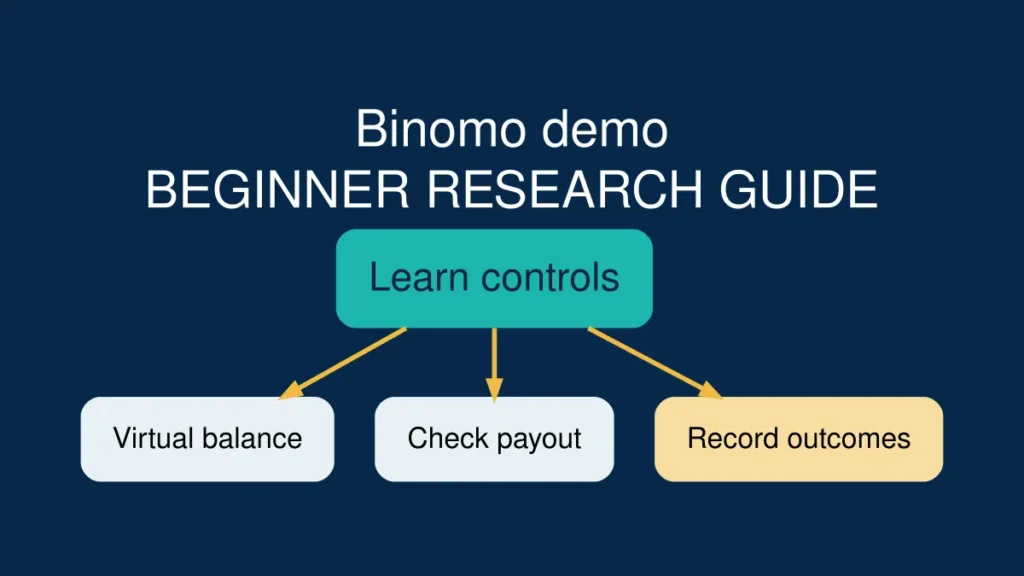
Binomo demo account searches usually come from beginners who want to practise without losing cash. A demo can help you understand a screen, but it cannot prove future income, legal status or successful withdrawals. Here is a research-first guide to using practice tools sensibly.
Reviewed for editorial accuracy: 20 October 2026. Platform details below are provider-published claims that can change; this is not an endorsement or real-money trading advice.
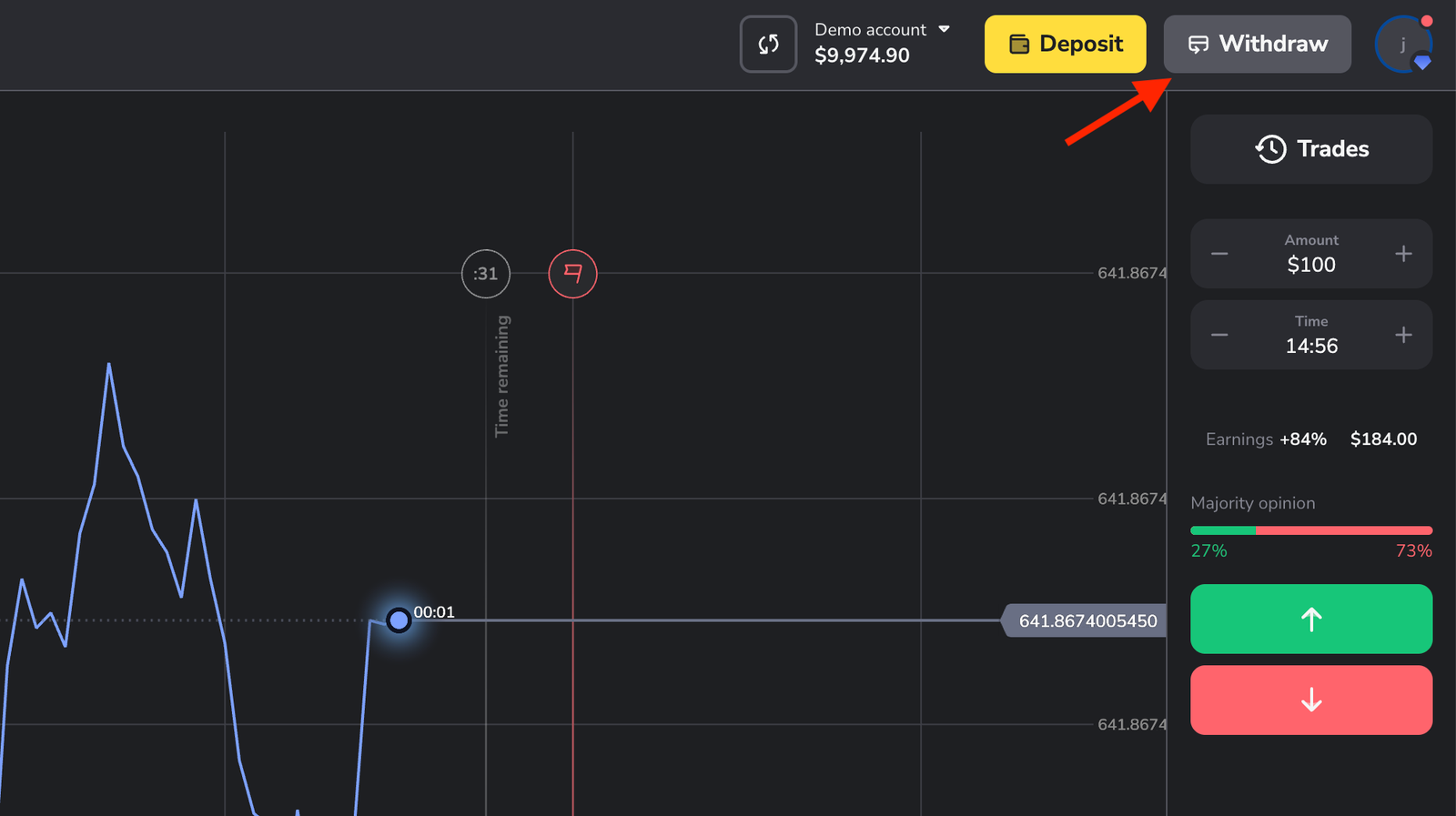
Source-specific demo limit: Binomo’s published demo-account help article describes a virtual $10,000 balance (or equivalent), non-withdrawable practice funds, and a limit of 30 demo trades before the first deposit. This is the provider’s stated access condition, not a reason to deposit funds. Learn the interface or study OHLC and payout maths without a funded account; separately verify local product eligibility.
What is a Binomo demo account, and what is it for?
A demo account is a practice environment in which an on-screen balance is used to explore an interface without putting the same amount of personal money into each example. Binomo-branded help material describes its demo balance as virtual and says that the amount is not withdrawable. This distinction should come before any discussion of hypothetical “profit.” Seeing the number on a practice account increase does not mean that money has arrived in a bank account, that a strategy is reliable or that a withdrawal from a real account would be accepted. The practical value of demo mode is narrower: learning how an asset is selected, where the reference price appears, what an expiry control does and how the interface reports an outcome.
Check the current help page rather than copying an old tutorial
A search result or video recorded last year may show buttons, access rules or account balances that differ from what the company currently publishes. A Binomo-branded Help Center article currently describes a $10,000 virtual demo balance, or an equivalent amount in the account currency, and mentions a limit of 30 demo trades before an initial deposit. Treat those as statements from that help page, not as independently verified promises of permanent access or an encouragement to deposit. The amount, limitations and country eligibility can change. When researching, open the relevant help document, record its URL and date, and check the actual legal operator and terms before creating any account. Do not assume a branded support domain is proof of financial authorisation.
Practice the five fields on the trading screen
Before touching a direction button, identify five items: the exact asset or reference instrument, the current displayed price, the amount at risk, the outcome or expiration time and the amount described as potential profit. An up-or-down control does not by itself mean that a user owns the underlying currency, stock or commodity. Some fixed-outcome products settle according to a yes-or-no condition rather than transferring ownership of an asset. The help material shows a process that involves selecting an account type, an asset, an amount and an expiry. Use those steps to learn where information appears on a screen, not to assume that clicking through them is a safe investing method.
A beginner exercise: observe instead of predicting
Open a chart in the practice environment, if it is available to you, and write down the time, the current price and the selected timeframe without placing any order. Wait until the current candle ends. Then record its opening price, closing price, highest price and lowest price. Repeat for five completed candles. The point of this exercise is to see that a moving candle can change its shape before closing. A red candle is not an instruction to select “down” next, and a green candle is not a guarantee of continuation. Learn to distinguish an observation from a forecast: “the last candle closed higher” is an observable statement, while “the next candle will rise” is an uncertain prediction.
Know the difference between virtual wins and actual earnings
Suppose a practice screen displays an 80% hypothetical profit payout on a 100-unit stake. If the prediction succeeds under those assumed terms, the profit is 80 units. The gross amount returned might be 180 units if the original stake is returned as well. If the prediction fails and the entire stake is lost, the outcome is minus 100 units. Those units inside a demo account are not money available for withdrawal. A balance that grows from simulated outcomes can be educational, but it does not demonstrate verified earnings, payment processing, identity checks or financial strength. Avoid sentences such as “make $80 in a minute,” because they blur the line between virtual arithmetic and real-world financial outcomes.
Why a 50% winning record may still lose money
A beginner might practise ten equal 100-unit hypothetical outcomes and record five correct and five incorrect predictions. At an 80-unit profit on success and a full 100-unit loss on failure, five wins add 400 units and five losses remove 500 units. The combined result is minus 100 units. Under those simplified conditions, the approximate break-even win rate is 100 divided by 180, or 55.56%. That is a mathematical threshold, not a success rate that beginners can be expected to achieve. A payout can change by instrument, time or contract. The correct calculation must use the current written settlement terms, not an old screenshot or a percentage copied from another person’s account.
Keep a practice journal that includes failures
One screenshot of a correct prediction provides almost no meaningful performance evidence. Set up a sheet with Date and Time, Instrument, Chart Timeframe, Expected Direction, Hypothetical Stake, Quoted Payout, Expiry, Outcome and Note. Write the entry before seeing the result; otherwise hindsight can make almost every chart look easy. Include every unsuccessful outcome and every skipped opportunity. After a small batch, review whether you made an observation about the chart or simply reacted to a recent winning or losing streak. Your journal is a record of what you practised, not a certificate that a strategy will work with real money. Do not use the same historic results to create and validate an accuracy claim.
Read a candlestick before reading trading signals
A completed candlestick displays the opening, highest, lowest and closing prices of one chosen interval. The body connects the opening and closing prices, while the wicks show extremes reached during the interval. A different timeframe can create a different pattern from the same underlying price series. A one-minute green body can occur within a larger downward move; a long upper wick can appear inside a range or around resistance without guaranteeing a decline next. If a social creator calls a shape a “sure-shot entry,” ask what complete test record supports that claim. Beginners benefit more from learning definitions, price sources and chart intervals than from memorising signals without context.
Understand expiry and the last-second illusion
In a fixed-time contract, the moment at which a result is measured may be crucial. A forecast about the next ten minutes and a contract expiring in sixty seconds answer different questions. A chart can move in the expected direction for part of an interval and still finish on the other side of the relevant strike or reference level. Fast countdowns and changing candles can create an impression of control without improving predictive evidence. Record the exact expiry used in any hypothetical practice example. Never assume that a pattern visible a few seconds before a candle closes remains identical after the final price is recorded, and do not treat last-second entry videos as independent proof of accuracy.
What demo mode cannot test about a real account
A virtual environment cannot show the financial pressure of risking savings. It also cannot, by itself, establish the outcome of a live withdrawal request, the identity documents required for verification, how customer complaints are handled, what happens during technical failures or which restrictions apply to a resident of a particular country. Even when charts seem similar, live and simulated conditions can differ in relevant ways. Separate two questions: “Do I understand the interface?” and “Is this operator authorised, transparent and suitable for this financial product?” A demo may help with the first question. The second requires legal documentation, direct verification and careful consideration of possible loss.
Research the operator, not just the brand name
A trading app’s name, colour scheme and logo are not evidence of regulatory permission. Find the exact legal entity identified in its current customer agreement, read the contract and identify which authority would regulate that product in your location. Then search that authority’s official register or published warnings. Do not assume the absence of a name from a single warning list means the service is approved; registers and warning lists have specific purposes. The ability to create an account from a country or receive a welcome message is not equivalent to authorisation. Treat any unsupported promotional claim as unverified, and date your findings because operators, names and terms can change.
Spot misleading ‘daily salary’ and bot advertisements
A message promising a fixed daily return from binary predictions is a warning sign, especially if it relies on a selective collection of screenshots. Someone selling an automated signal service may have an incentive to show successful examples while hiding losses or changing payout conditions. A high backtest accuracy can also result from tuning rules on past data that was used to choose the rules in the first place. Ask for a complete, independently verifiable record, including timestamps, unsuccessful predictions, real versus simulated status and the method for calculating net returns. Even a detailed record describes the past, not the next outcome. Be cautious of bots or browser extensions that request login tokens, passwords or remote access to your device.
Account security starts before any deposit
Research an app’s official download channels instead of trusting a link shared in a private chat. Check the domain spelling, the company name in the privacy notice and the permissions requested by any installed software. Do not share your password, SMS code, one-time code, authentication token or screen control with a person claiming to be support. Financial scams may imitate logos or helpdesk accounts to capture these details. If a problem relates to a transaction, use the provider’s documented complaints route and keep a private record of the correspondence. When a platform requests identity documents, investigate its privacy practices and legal status first rather than uploading sensitive information merely to explore a demo interface.
A simple 20-minute educational practice plan
During the first five minutes, identify the five basic screen fields and write down what each one means. Spend the next five minutes watching completed candles without placing a simulated order. Use another five minutes for payout calculations with a hypothetical 100-unit stake at 70%, 80% and 90% profit payouts; note how an unsuccessful result differs from a successful one. Use the final five minutes to record what remains unverified: the legal entity, live contract, support process, local rules and data-handling terms. At the end, you should know more about the product without needing to fund an account. If confusion remains, repeat the research rather than treating urgency as a reason to move forward.
Demo and live: comparison table
The important distinction is not whether the screens have the same colour or layout. In a practice balance, example outcomes affect virtual units; in real-money activity, unsuccessful outcomes can reduce actual savings. A simulated success does not establish that money can be withdrawn. Interface familiarity is useful, but it should never be confused with a verified financial return. The table below summarises the educational difference without making claims about every platform’s current functionality.
What should a careful beginner do next?
A sound next step may be to keep learning rather than open or fund an account. Review the contract’s possible loss, the regulator’s official guidance and the difference between fixed-outcome binary products and ordinary asset ownership. If you use a demo interface, treat it as a simulator and keep honest records. Use our payout calculator for arithmetic and read country rules separately. Essential expenses, emergency savings and money borrowed to repay debt should not be exposed to speculative all-or-nothing contracts. No number of simulated wins creates an obligation to make a real-money trade, and declining the product is a valid decision.
| Question | Demo / practice | Real-money contract |
|---|---|---|
| Money at risk | Virtual balance | Actual funds can be lost |
| Does a green result prove income? | No | A single win still does not show long-term profit |
| What can be learned? | Controls, candles, settlement maths | Actual financial outcome and account terms |
| Does it prove legal approval? | No | Requires separate regulatory checks |
Frequently asked questions
Is a Binomo demo balance real money?
No. The Binomo-branded help article says practice funds are virtual and cannot be withdrawn. Confirm the most current details from the source before relying on them.
Does a practice winning streak predict what will happen with real funds?
No. A sample of simulated outcomes does not establish a stable win rate, a legitimate operator or a future return.
Do I have to make a deposit to learn candlestick charts?
No. Learning OHLC data, chart timeframes and payout maths does not require committing personal money to a binary contract.
Why do wins and losses add up differently?
A common fixed-outcome structure may pay 80 units of profit on a 100-unit successful stake and lose 100 on failure. The win-rate threshold therefore exceeds 50%.
Does app accessibility prove it is regulated in my country?
No. Verify the exact entity, product and relevant local authority through current official sources.
Should I use paid signals while practising?
Claims of guaranteed signal accuracy are not reliable evidence. A beginner can learn chart definitions and financial-risk mathematics without buying a signal product.
Primary sources and related learning
- Binomo-branded Help Center: What is a demo account? — source of reported virtual balance and access conditions (verify the operator independently).
- Binomo-branded Help Center: Order-screen explanation — platform’s own description, not an independent safety assessment.
- Investor.gov: Binary Options Fraud — official US investor education on contract structure and warning signs.
- BBH Academy and Country Rules for separate educational topics.
Related research: Read our Binomo review for a separate look at platform terms and risks, and use the BBH payout calculators to check hypothetical payout arithmetic. Neither resource establishes future success or authorisation.
Bottom line: A demo can teach buttons, charts, expiry and payout maths. It cannot promise a winning strategy, verify a broker or turn simulated units into a salary. Research the product and your country rules without pressure to deposit.