


We may earn a commission through these partner links. Demo funds are virtual; access and country eligibility depend on the platform terms. Disclosure
Quotex fees cannot be summarised accurately as “everything is free.” Its homepage says there are no broker deposit/withdrawal fees, while the detailed FAQ states a same-day withdrawal condition. Payment-provider deductions and conversion also need separate checking.
Research updated 23 October 2026. Official-source comparison and hypothetical calculations; no funded transaction or authenticated fee preview tested.
Quotex deposit and withdrawal fees: compare the official sources
| Source | Published statement | Practical implication |
|---|---|---|
| Homepage FAQ | No broker deposit/withdrawal fees; third-party fees and conversion may apply. | A zero platform headline is not zero total cost. |
| Detailed financial FAQ | Deposits free; 3% from the third withdrawal within the same day. | Check withdrawal count and the current quote. |
| Payment Policy 4.6 | Company-set withdrawal costs and conversion rates can change. | Preserve the version and route-specific disclosure. |
These statements are not identical. This guide keeps the discrepancy visible instead of treating a no-fee headline as unconditional. Ask which terms apply to your particular request and save the answer alongside the transaction.
We did not test how the daily condition is implemented. In particular, this research does not establish the reset timezone, treatment of cancelled requests or every possible account-specific exception.
How does the published 3% withdrawal condition affect the amount?
The arithmetic is charge = gross amount × 0.03 when that percentage applies. The remainder before other costs is gross amount × 0.97. The examples below illustrate the FAQ percentage; they do not confirm that any reader’s request qualifies.
| Illustrative gross request | 3% component | Before other costs |
|---|---|---|
| US$50 | US$1.50 | US$48.50 |
| US$100 | US$3 | US$97 |
| US$250 | US$7.50 | US$242.50 |
Before splitting money into several requests, ask how transactions are counted and what the preview will deduct. Do not assume cancellation resets a counter. Keep the original confirmation even if a later replacement request is created.
Nor should this calculation be read as advice to leave funds with the platform to avoid a charge. Availability, access and counterparty exposure are separate considerations. The purpose is to make a quoted cost understandable.
Quotex deposit fees: distinguish funding from a charge
The advertised deposit threshold is an incoming funding amount, not a fee paid for opening a trade. Read our Quotex minimum-deposit guide for the entry threshold, local-currency examples and small-balance maths.
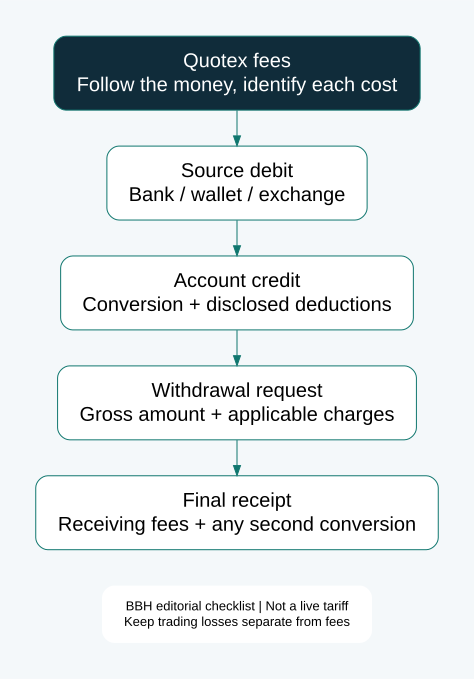
A zero explicit deposit charge can still coexist with a bank charge, wallet conversion or a difference between the source debit and account credit. Record both sides rather than assuming the number displayed in an advert is the total amount leaving your payment source.
Compare the actual currency units. A debit in rupees and credit in dollars need a stated conversion basis before a meaningful percentage can be calculated.
Currency conversion: calculate the effective rate
For funding, divide the source-currency debit by the account-currency credit. For an outgoing payment, record its own rate and deductions separately. A reference rate should be dated and identified if used to measure a difference.
Illustrative funding example: ₹8,700 leaves the source and US$100 is credited. The effective rate is ₹87 per credited dollar. If a stated comparison rate is ₹85, US$100 at that reference is ₹8,500. The ₹200 difference is approximately 2.35% of the reference value.
These invented amounts do not establish Quotex’s current rate or prove which party retained the difference. Separate explicit fees from conversion pricing and from exchange-rate movement over time.
For a return example, suppose US$97 is released and a hypothetical receiving rate is ₹84. The converted amount is ₹8,148. A separate ₹100 receiving deduction would leave ₹8,048. A headline 3% condition alone would not describe that complete journey.
A net-receipt worksheet for a specific withdrawal
| Field | Record | Why it matters |
|---|---|---|
| Gross request | Amount and account currency. | Establishes the starting figure. |
| Platform deduction | Quoted amount, condition and rate. | Separates an explicit platform charge. |
| Released payment | Amount, currency and reference. | Identifies what left the platform process. |
| Conversion | Rate and time fixed. | Explains a currency change. |
| Receiving deduction | Institution and statement entry. | Identifies a later cost. |
| Net receipt | Final credited amount. | Completes the reconciliation. |
For the actual procedure and timeline questions, see the Quotex withdrawal guide. This article concentrates on cost attribution so the two pages answer distinct questions.
If the figures do not reconcile, ask for a breakdown rather than assigning an unexplained shortfall to a “hidden fee.” A mismatch is a fact to investigate; its cause needs evidence.
Crypto network fees and receiving-exchange charges
Keep three possible records separate: the charge quoted to the customer, the blockchain transaction and any receiving-service deduction. Their amounts need not describe the same thing.
Record asset, network, gross amount, expected net amount and any required memo/tag. If transferred, obtain the transaction hash. A blockchain fee associated with several batched payments is not automatically the fee charged to one customer.
A confirmed blockchain transaction also does not establish that a receiving exchange credited the customer account. Payment tracing and fee reconciliation overlap, but they answer different questions. Never disclose a private key or recovery phrase to investigate either.
Trading commission, payout and losing stakes are different
Quotex’s Trading Operations Rules, clause 4.10, state no commission is charged on the operation amount. That is product-specific published wording; it does not establish zero costs throughout the payment journey.
In a hypothetical fixed-outcome contract, a US$10 stake with an 80% profit payout adds US$8 on a win and loses US$10 on a loss. One win plus one loss produces minus US$2 before payment costs. That US$2 is not a withdrawal charge.
The simple equal-stake, no-tie, no-extra-cost break-even rate is 1 ÷ (1 + payout fraction). It is about 55.56% at 80% payout and about 58.82% at 70% payout. Neither figure is an estimate that a strategy can achieve that performance.
Use the calculation tools with their assumptions. Do not turn a lower explicit commission into a claim of easier profitability.
Inactivity, account maintenance and overnight fees
Do not copy a forex swap schedule onto a different fixed-outcome product. Likewise, do not use a general comparison table to declare every optional service permanently free.
This research did not establish a complete current tariff for every account-related charge. An inactivity-related account-closure statement is not the same as a monthly inactivity fee. Ask for the exact condition, trigger and amount if such a charge is alleged.
A responsible table can say “not established in this review” instead of inventing zero. That qualification is more useful than a precise number with no applicable source.
Minimum withdrawals and bonus conditions are not ordinary fees
A threshold controls whether a request can be placed; it is not automatically a deduction. A promotional turnover requirement can restrict access without appearing as a transfer fee. Keep these categories separate in a comparison.
Before accepting a bonus, ask how cancellation affects your own deposit and related results. Do not treat promotional credit as cash merely because it is displayed beside the balance.
Verification is another separate condition. Read Quotex KYC guidance; a pending identity task should not be labelled a fee unless there is an actual, verified charge.
How to question an unexpected Quotex deduction
Transaction [ID], dated [time/timezone], requested [amount/currency] and credited [amount/currency]. Please explain each deduction, the conversion rate, whether the same-day withdrawal condition applied and which party charged each component. Please provide the relevant tariff or policy reference.
Attach the necessary redacted records through genuine support. Preserve the original quote, reply and chronology. Never post unredacted card details or credentials in a public fee discussion.
If someone privately demands a new payment to release a balance, independently verify the recipient and basis through the genuine account. Do not assume an extra transfer is a normal fee simply because the message uses a broker logo.
Quotex fees: FAQs
Are Quotex withdrawals always free?
The detailed FAQ includes the same-day condition, while the homepage wording is broader. Confirm the applicable request terms rather than omitting the discrepancy.
Is currency conversion always 3%?
This review establishes no universal fixed conversion percentage. Do not confuse the FAQ’s withdrawal condition with a conversion tariff.
Is a deposit minimum a fee?
No. It describes funding required to meet an incoming threshold, not a separate charge. The balance can still be lost through trading.
Can I measure total cost from account profit alone?
No. Separate trading results, payment movements and conversion before calculating the cost journey.
Sources and scope
Checked 23 October 2026: homepage FAQ, detailed financial FAQ, Payment Policy and Trading Operations Rules. Public statements are not independently measured charges. Examples are hypothetical.
Continue with the Quotex review, payments research hub and methodology.
Risk: Fixed-outcome contracts can lose the full stake. Zero explicit commission does not establish safety, authorisation or future profit.