


We may earn a commission through these partner links. Demo funds are virtual; access and country eligibility depend on the platform terms. Disclosure
Stake percentage is a comparison between a proposed contract amount and a clearly defined account balance. It helps describe exposure, but no percentage makes an unsuitable product safe or turns negative expected value positive. Fixed money and fixed fraction also behave differently after losses.
Research checked 23 October 2026. Percentages and balances below are hypothetical learning scenarios, not recommended position sizes.
How to calculate stake as a percentage of balance
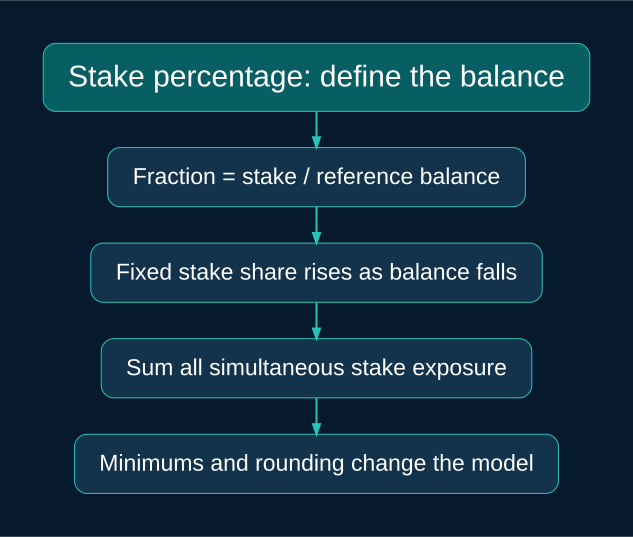
Stake percentage = stake ÷ reference balance × 100. A five-unit stake against 500 units is 1%; against 100 units it is 5%. The same nominal amount can therefore represent very different exposure.
Define the denominator before comparing records. Available cash, settled balance, marked equity and a displayed total containing promotional credit need not be interchangeable. Preserve the platform’s accounting definitions and record which amount was used.
If a contract can lose its full stake, that stake describes the contractual loss exposure under those terms. It does not describe every provider or operational risk affecting the rest of an account. Product-specific exceptions and fees also need separate treatment.
5 ÷ 100 = 5%
5 ÷ 75 = 6.67%
Bar scale: 100% width represents a 10% stake fraction. Invented example, not an allocation recommendation.
Fixed amount: the fraction rises as balance falls
Consider a hypothetical starting balance of 100 units and a constant five-unit stake. After five consecutive full losses, balance is 75. The next five-unit stake represents 5 ÷ 75 × 100, approximately 6.67%.
| Losses already incurred | Balance before next entry | Next fixed stake | Fraction exposed |
|---|---|---|---|
| 100 | 5 | 5.00% | |
| 1 | 95 | 5 | 5.26% |
| 3 | 85 | 5 | 5.88% |
| 5 | 75 | 5 | 6.67% |
| 10 | 50 | 5 | 10.00% |
The money setting never changed, but its share of the remaining balance doubled between the first and last rows. Calling a fixed five-unit amount “always 5% risk” would be incorrect for this path.
Fixed fraction: the amount changes with the reference balance
Under an illustrative fraction f, the next stake is f × current reference balance. With full-stake losses, no other flows and exact fractional acceptance, each loss multiplies balance by (1 − f). After k losses, balance is B0 × (1 − f)^k.
At a hypothetical 5% fraction, five losses from 100 leave 100 × 0.95^5, approximately 77.38 units. Ten leave approximately 59.87. These are model outputs, not an endorsement of a 5% setting.
| Full losses | Fixed five-unit amount | Exact 5% fraction |
|---|---|---|
| 100.00 | 100.00 | |
| 1 | 95.00 | 95.00 |
| 5 | 75.00 | 77.38 |
| 10 | 50.00 | 59.87 |
The comparison assumes no rounding, minimum stakes or fees. Real accepted amounts can depart from the formula. A model that approaches zero without reaching it does not establish that a real account can continue indefinitely.
What happens after a win?
For a simple contract earning net payout r on a win, an exact fractional stake f produces a balance multiplier of (1 + f × r), assuming no other flows or costs. At f = 0.05 and r = 0.80, that multiplier is 1.04.
A full loss followed by a win therefore multiplies balance by 0.95 × 1.04 = 0.988. Starting at 100 leaves 98.80. One win does not offset one loss under these assumptions, even though both stakes used the same fraction.
Several small contracts can create large combined exposure
If five simultaneous contracts each stake two units against the same 100-unit reference, their total stake is ten units, or 10%. Each individual entry being 2% does not make the combined contractual exposure 2%.
Record whether percentages use the balance before all entries or available funds after earlier stakes were reserved. Those denominators differ. Keep a consistent aggregate measure so a sequence of entries cannot conceal the total money committed.
Related instruments and overlapping expiries can also produce losses together. Different asset names do not establish independence. A percentage table needs the actual open-exposure record alongside it.
Minimum stakes and rounding can override the intended fraction
Suppose a hypothetical minimum stake is one unit. Against a 40-unit balance, that minimum is 2.5%. A proposed 1% fraction would equal 0.40 units and would not satisfy the assumed minimum. Raising it to one changes the model.
Similarly, rounding a proposed 0.96 to one produces a larger fraction than intended. Save the requested amount, accepted amount and reason for any difference. Do not quietly continue calling the result an exact fixed-fraction test.
Check the selected product and account rather than relying on a generic broker minimum. A trading minimum, deposit minimum and withdrawal minimum are different conditions.
Bonuses and deposits change the interpretation
A displayed total containing bonus credit is not necessarily entirely withdrawable cash. If a sizing formula uses that total, disclose the balance definition. Do not describe promotional credit as equivalent to a cash reserve without checking the terms.
New deposits also change the denominator. Moving a five-unit stake from 5% to 2.5% by depositing another 100 units does not recover the earlier loss; it adds external funds. Preserve cash flows separately from trading results.
Sizing is not a predictive edge
Investor.gov’s binary-options resource explains the significance of unequal winning rewards and losing stakes. A smaller amount changes money exposed, not the conditional probability or payoff ratio.
For the simple model with 50% win probability, 80% net payout and full losses, expected result is −0.10 per unit risked. Multiplying the amount does not improve that per-unit figure under the same assumptions. This illustration does not assert a measured win probability for any strategy.
A practical stake-exposure worksheet
- Define balance: state available cash, equity or another documented reference.
- Identify the product: full symbol, account environment and loss terms.
- Record amounts: proposed and accepted stake, with rounding.
- Calculate the fraction: retain the denominator used at decision time.
- Sum exposure: include other open contracts and overlapping risks.
- Track flows: separate deposits, withdrawals and promotional credits.
Use virtual scenarios to learn the accounting. No single stake percentage is established here as appropriate for every reader, balance or financial situation. Increasing a fraction to regain a peak can increase the depth of later losses.
Frequently asked questions
Is fixed amount the same as fixed percentage?
No. A fixed amount changes its share as the reference balance changes.
Does a small fraction guarantee safety?
No. Repeated losses, combined exposure and provider risks remain.
Should a calculator include open stakes?
It should explicitly define their treatment. A calculation without that accounting context can understate aggregate exposure.
Sources and further learning
The official resource supports the attributed payoff caution. Formula comparisons and worksheet are educational analysis. See our calculation tools, demo practice guide and methodology.
Risk: Fixed-outcome contracts can lose the full stake. Stake sizing cannot guarantee profit or make recovery certain.