


We may earn a commission through these partner links. Demo funds are virtual; access and country eligibility depend on the platform terms. Disclosure
A same-payment-method withdrawal rule can restrict both where money goes and how much can be returned through a route. “Same card”, “same account” and “same payment system” are not necessarily interchangeable. Read the applicable provider wording before replacing a destination.
This guide compares selected Pocket Option, Quotex and Deriv public terms, then explains how to document an unavailable funding method, multiple deposits or a proposed alternative. Sources were checked on 24 October 2026. An exception requires applicable terms and provider confirmation, not an assumption based on another customer’s experience.
What the reviewed same-method rules actually say
| Provider | Reviewed public wording, paraphrased | Question to resolve |
|---|---|---|
| Pocket Option | The payment policy identifies the original account/card, payment system and wallet ID. It allows discretionary exceptions, may limit a route to deposits through it, and addresses an agreed method for excess profit. | Which original destination and amount rule applies, and is a proposed exception approved? |
| Quotex | The FAQ says the deposit method is also the withdrawal method, with Visa as an example. | What specific account or destination is permitted under the applicable payment policy? |
| Deriv | Funds and Transfers clause 1.11 requires the deposit method for withdrawals. The terms note methods may change and prohibit sharing payment methods with another client. | What is the documented resolution if the original method is unavailable? |
These rules support checking the original route; they do not establish one identical worldwide allocation formula. The exact entity, method, currency and current account instructions matter. A broad FAQ should not be stretched into an unverified exception.
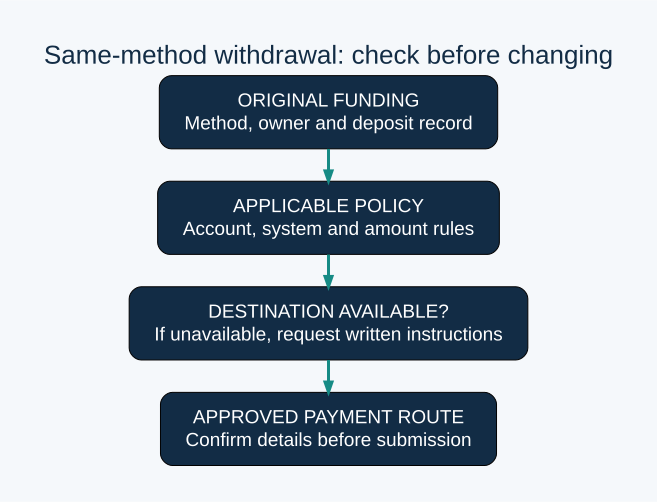
Same method, same owner and same destination are separate checks
Two cards can belong to the same person but represent different destination identifiers. Two wallets can use the same brand but be separate accounts. A common payment-system logo therefore does not, by itself, answer a rule that refers to the original wallet ID.
Ownership is another question. A destination being technically able to receive money does not establish that you are authorised to use it for the account. Preserve the funding evidence and ask for the exact requirement instead of treating any newly added card as automatically eligible.
Currency adds a further layer: account currency, deposit currency and receiving currency may differ. Ask whether the proposed transaction is a return of original funding, a payout of proceeds or a conversion. Record the quoted rate and expected net amount independently of destination approval.
Build a funding ledger before requesting a change
| Field | What to retain privately |
|---|---|
| Funding event | Date, amount, currency and transaction reference. |
| Method and identifier | Card/wallet/bank route with a safely masked account identifier. |
| Ownership | Relevant confirmation from the institution or account record. |
| Previous returns | Completed withdrawals or refunds linked to that route. |
| Current problem | Expiry, closure, replacement or missing method notice. |
| Requested resolution | Proposed route and written provider instructions. |
A useful ledger separates money paid from money credited to the trading account. Conversion and charges can make these amounts different. Keep the original receipts rather than reconstructing a funding history from the latest balance alone.
Expired, replaced or blocked card: ask before rerouting
First distinguish an expired card number from a closed underlying bank account. Ask the issuing institution whether an incoming return linked to the original transaction can still be received and what evidence it can provide. Do not assume every issuer handles replacement cards the same way.
Then tell provider support exactly what changed and ask for its approved procedure. It may request evidence of ownership or unavailability; obtain the actual requested list rather than sending an entire bundle of unrelated personal documents.
Keep the destination-change decision in writing, including any amount limits or conditions. A bank’s explanation of its receiving capability and the trading provider’s authorisation are separate pieces of evidence. One does not automatically replace the other.
Closed wallet or a missing payment option
If a wallet was closed, retain the closure record and ask the wallet provider how any attempted return would be handled. If the wallet still exists but disappeared from the trading interface, preserve the screen and ask whether the issue is availability, region, currency or account eligibility.
Do not create a duplicate trading identity to work around the restriction. Nor should you use another person’s wallet simply because it appears in the available-method list. Request a permitted route tied to your own account and the actual funding history.
Multiple deposit methods and profit: use numbers carefully
Imagine deposits of 100 units through a card and 50 through a wallet, with no conversions or fees. Total contributions are 150. If the account later holds 180 after settled trading, the difference is 30. That arithmetic does not establish permission to send all 180 to the wallet.
Now suppose 40 units were previously returned to the card. The ledger shows original contributions of 150, previous returns of 40 and a remaining funding difference of 110. This is a bookkeeping observation, not a provider allocation rule.
Ask whether the applicable policy uses original funding amounts, remaining refundable amounts, proportions, a priority sequence or another method. Request an explanation of how previous withdrawals and additional proceeds affect it. Do not copy an allocation formula from a different brand.
Splitting a request may be appropriate only if the provider’s documented instructions permit it. Splitting alone does not override ownership, destination or review conditions, and it may affect costs. Confirm the rule before creating several transactions.
A legitimate exception needs a traceable decision
A useful approval identifies the account, reason the original method cannot receive, approved alternative, ownership requirements and any amount or currency limitation. “Try another method” without those details can leave the same problem unresolved.
If the written policy and support answer appear inconsistent, ask for the relevant clause and a review of the proposed route. Preserve both records. Do not interpret an ambiguous response as permission to conceal the source, mislabel a payment or bypass identity checks.
Support-message template for an unavailable funding method
I funded account [masked ID] using [method/masked identifier] on [dates] for [amounts/currencies]. Previous returns through this route total [amount]. The original destination is now [expired/replaced/closed/unavailable], supported by [relevant evidence]. Please identify the applicable same-method rule and the authorised resolution. If an alternative is allowed, please confirm its ownership requirements, amount limits, currency, documents and any fees before I submit it.
Use secure authenticated support for evidence. Do not send passwords, OTPs, CVVs or seed phrases. Keep an unredacted private chronology and redact identifiers in public discussions.
Frequently asked questions
Can I withdraw to a different card in my own name?
Ownership alone does not establish permission. Confirm the account’s applicable rule and obtain instructions for the replacement destination.
Does an expired card mean the money is lost?
Expiry alone does not determine the outcome. Ask the issuer about receiving capability and the provider about its authorised return process.
Can a family member receive the withdrawal?
Do not assume that relationship makes a third-party destination acceptable. The reviewed ownership and method restrictions require checking your own permitted route.
Should I deposit through a new method to activate it?
Do not make a fresh deposit on an unofficial instruction. Ask whether a change is required and supported by the applicable terms before moving more money.
Does a payment exception prove regulatory approval?
No. A permitted destination and legal availability of the underlying product are separate questions.
Official sources and related reading
- Pocket Option payment policy: section 3 and clauses 5.1 and 5.11.
- Quotex FAQ: deposit and withdrawal method wording.
- Deriv Funds and Transfers: method and ownership restrictions.
Related: Payments research hub · Pocket Option withdrawal guide · Quotex withdrawal guide · Research methodology.
Scope: Checked 24 October 2026. Examples are illustrative, not an account-specific allocation decision or legal advice. Provider documents describe conditions, not independently tested payment performance.