


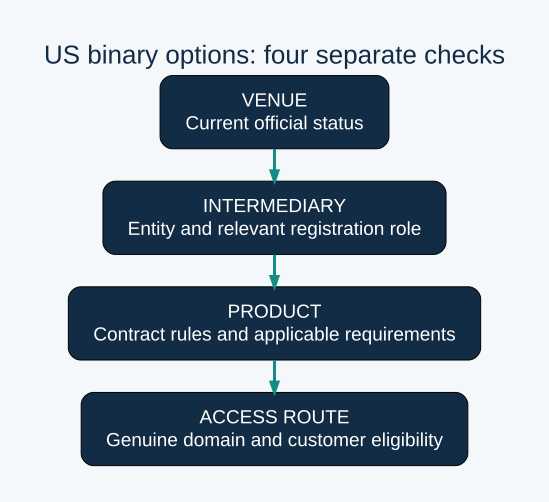
US binary-options research requires checking the venue, intermediary, product and genuine access route. An offshore website accepting a US address is not equivalent to a verified regulated arrangement. A copied registration number cannot settle the question.
This guide explains a practical verification process using current official resources checked on 24 October 2026. It does not provide a list of approved brokers or classify every event contract. Specific federal, state and product requirements need assessment for the actual arrangement.
Avoid a blanket legal claim based on the product nickname
The CFTC describes designated contract markets as exchanges under its oversight that may provide retail access. Its guidance also distinguishes securities and securities-index options under SEC jurisdiction. A generic binary-options advertisement does not identify which framework, venue or permission applies.
Investor.gov warns that much internet-based binary-options activity may not comply with US requirements. It describes complaints involving withheld funds, identity misuse and alleged software manipulation, and directs readers to independent background checks including IAPD and NFA BASIC.
Those warnings justify examining the arrangement. They are not proof that every contract with a yes/no outcome is identical, or a finding that an unnamed platform committed a specific offence.
Use the current CFTC venue record
The CFTC’s current trading-organisations list includes separate status fields such as Designated, Pending, Dormant and Vacated. Inspect the actual entry, relevant documents and date instead of treating any search result as evidence of active designation.
A pending application is not the same status as designation. A historical name can also differ from a current legal name. Preserve the record and its remarks so a later comparison does not accidentally join two different entities.
Do not reproduce a fixed “only two” or “only three” venue count from an old article as a current fact. Likewise, a venue entry alone is not a conclusion about every contract or customer route associated with that name. Check the product’s own current specification and applicable restrictions.
Match the intermediary, website and actual role
Record the company named in the agreement, the domain used for onboarding and any intermediary involved. Search the appropriate official database independently and compare the relevant registration role, status and identifiers.
Finding a genuine record for a similar name does not establish that the website belongs to that organisation. A seller can quote another firm’s details. Use independently verified contact information to resolve a discrepancy rather than replying only through the original message.
| Check | Record to retain | What it does not establish alone |
|---|---|---|
| Venue | Exact name, status and dated official entry. | Permission for every advertised product. |
| Intermediary | Legal entity and relevant registration role. | Ownership of a lookalike website. |
| Product | Rulebook, settlement specification and restrictions. | Suitability or a profitable outcome. |
| Access | Authentic onboarding and eligibility conditions. | A general exemption from other requirements. |
Event contracts and prediction-market labels need specific research
Do not assume every event contract is a broker-style short-expiry wager, or that a prediction-market label removes applicable requirements. Identify the issuer, venue, event, settlement conditions and customer location before drawing a conclusion.
An announcement about a different platform or a different contract cannot be copied into your case without checking its scope. If litigation, an order or an exemption is material, read the current relevant source and seek advice for the actual arrangement.
This article deliberately uses a verification framework rather than claiming that one market’s status resolves every federal and state question. It also does not recommend changing a location declaration or using a VPN to bypass eligibility checks.
Contract price and percentage payout are different conventions
For a hypothetical purchased contract costing 40 units and settling at 100 on success or zero otherwise, the successful gross profit is 60 and the unsuccessful loss is 40, before costs. The 100-unit settlement includes the original 40-unit outlay; it is not 100 units of net profit.
If a simplified fee of one unit applies regardless of outcome, net results become +59 or −41. With a modelled success probability p, expected net result is 100p − 41. Break-even in that assumed model is p = 41%, not a claim about actual event probability.
Compare that with a fictional stake-based contract paying 80% net profit on a win and losing the whole stake on a loss. Its cash-flow convention differs. Do not place both in a “payout percentage” ranking without translating the amounts, costs and assumptions.
These calculations explain arithmetic only. They do not identify a current venue, establish customer eligibility or predict an outcome. A quoted contract price also should not be relabelled as a guaranteed win probability.
A useful offer-review evidence pack
- Save the full advertisement, domain, contact route and date.
- Identify the contracting entity, venue and any intermediary separately.
- Preserve independent official records and their current status.
- Save the actual contract’s expiry, payoff and settlement source.
- List customer restrictions, fees and withdrawal conditions.
- Record unresolved claims instead of filling gaps with a competitor’s comparison table.
For example, “the platform accepts US registrations” is an operational observation. “The offer is permitted for this US customer” requires additional evidence. Keep those statements separate in a research note.
If funds or documents have already been sent
Retain account statements, payment references, communications and the entity claimed by the service. Secure exposed credentials through a trusted route and contact the payment institution promptly about suspected fraud or unauthorised activity.
Use genuine regulator complaint or reporting channels appropriate to the instrument and conduct. A payment trace, regulatory report and legal claim perform different functions; none should be described as an automatic refund mechanism.
Do not send additional funds or authentication secrets because an unsolicited caller promises to unlock a withdrawal. Ask for the underlying requirement through the genuine organisation and preserve the response.
Frequently asked questions
Does accepting US customers prove a broker is regulated?
No. Registration access is not a substitute for the entity, venue, product and eligibility checks.
Does a pending venue application mean approval?
No. Preserve and interpret the exact current status rather than treating every list entry alike.
Is a regulated venue a guarantee against loss?
No. Regulatory status and investment outcomes are different questions; the contract can still lose the amount at risk.
Can a historic broker list be used unchanged?
No. Recheck names, statuses, products and access conditions against current official records.
Official sources and related research
- CFTC DCM framework.
- CFTC current venue-status records.
- Investor.gov binary-options fraud and background-check guidance.
Country research hub · Payment research · Research methodology.
Scope: Checked 24 October 2026. General documentary research and illustrative arithmetic, not individual legal advice, an approved-provider list or funded-account testing.