


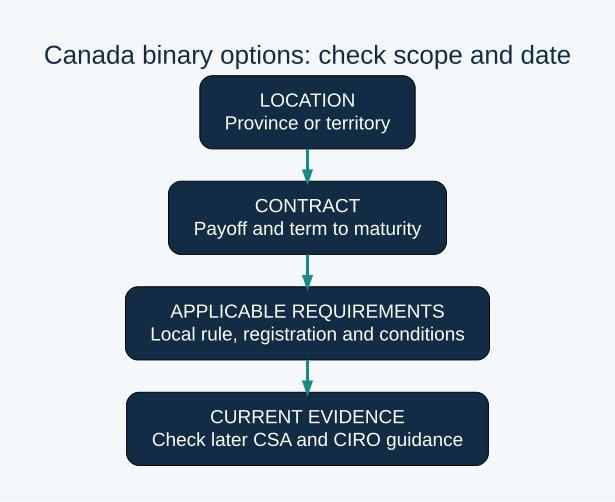
Canada’s binary-options rules require attention to contract duration, customer location and the exact arrangement. The short-duration prohibition is not a statement that every longer event contract is automatically permitted. Offshore access is not evidence of Canadian authorisation.
This guide combines the CSA’s historical announcement with its April 2026 reminder on event contracts, plus British Columbia-specific material. Sources were checked on 24 October 2026. Keep each document’s date and scope visible instead of blending them into one blanket claim.
What the CSA announcement says about less than 30 days
The CSA’s September 2017 announcement describes Multilateral Instrument 91-102 as prohibiting advertising, offering, selling or otherwise trading binary options shorter than 30 days with an individual. It points to participating jurisdictions’ instruments and separate British Columbia information.
Do not infer permission from the absence of one prohibited element. A 30-day-or-longer term still needs assessment against applicable securities or derivatives requirements, entity permissions and customer conditions. Changing an expiry in a marketing table does not settle those questions.
Record the actual term to maturity and the contract specification. The fact that a website says “monthly” is less precise than a documented issue time, expiry and relevant rule. Ask for the governing terms if the duration is unclear.
The April 2026 CSA/CIRO reminder changes the context
On 2 April 2026, CSA and CIRO said event contracts that are securities or derivatives must meet applicable requirements, including registration or recognition. They reiterated the less-than-30-day prohibition in some CSA jurisdictions.
The notice said two CIRO members were then authorised to facilitate Canadian access to certain event contracts, including on foreign regulated prediction markets, subject to conditions. It also said no prediction market had then been recognised as an exchange, registered as a dealer or exempted by the CSA. Conditions could change.
This is a dated, conditional statement. It is not blanket approval for offshore binary platforms or direct access to any prediction market. Nor should the “two” count be presented as a freshly verified current count in October without checking later records.
When a seller cites that development, ask for the actual dealer, permitted product and current conditions. A headline about access through a specified arrangement does not resolve the status of an unrelated website.
Why province or territory still matters
Canadian securities regulation includes provincial and territorial authorities. The CSA coordinates their work, but a national press-release headline does not replace the applicable local instrument, order or registration record.
BC Notice 2017/02 separately warned that binary options could not legally be advertised, offered, sold or traded to retail investors in British Columbia under the circumstances it described. It discussed the absence of registered sellers and required securities disclosure. Read it as a dated BC source alongside any later relevant rules or decisions.
If the customer moved, the service changed entities or the arrangement uses a foreign venue through an intermediary, preserve those facts. Do not assume the location of the underlying asset alone determines which customer rules apply.
A 29-day versus 31-day example
Imagine a fictional seller changes a product’s advertised term from 29 days to 31 days and claims it is now “Canada approved”. The duration change answers one narrow question about the stated term. It does not prove registration, recognition, an exemption or compliance with every other applicable requirement.
Similarly, “the US exchange is regulated” does not identify the permitted Canadian customer route. Ask who facilitates access, what conditions apply and which official record supports the arrangement.
These examples explain evidence gaps, not a legal determination about a specific unnamed product. Unusual contracts, exemptions or customer classifications require advice suited to the actual facts.
A Canadian offer-review worksheet
| Field | Evidence to retain | Question it answers |
|---|---|---|
| Customer location | Relevant province or territory. | Which local authority and requirements need checking? |
| Contract | Payoff, issue details and term to maturity. | What is actually being offered? |
| Issuer and intermediary | Separate legal names and roles. | Who contracts with or facilitates access for the customer? |
| Venue | Exact market and current official record. | Where does the contract trade? |
| Permission or exemption | Applicable dated record and conditions. | Does the evidence match this arrangement? |
| Contact route | Independently verified domain and details. | Is the offer genuinely connected to the named entity? |
A useful conclusion records what remains unresolved. For example, an authentic foreign incorporation certificate may identify a company but leave its Canadian permissions unanswered. Authenticity and legal relevance are different checks.
Fake CSA accreditation and guaranteed-return claims
The CSA’s February 2021 Mercury Crypto Invest warning described false accreditation claims and advertised guaranteed returns with a 95% win rate. It explicitly said there is no such thing as a “CSA-accredited trader”. This is a specific warning about misrepresentation, not an endorsement of other sellers using different wording.
Verify claims independently instead of opening only the certificate or register image supplied by the advertiser. A regulator’s logo copied onto a PDF does not establish any relationship with that regulator.
If an offer combines a licence claim, urgency and an instruction to pay a private destination, preserve the whole conversation. Do not allow one apparently genuine detail to substitute for the remaining checks.
If an account, withdrawal or payment is disputed
Keep the agreement, actual contract term, payment references, account history and dated communications. Describe the unresolved event precisely: an unpaid request, unexpected deduction or missing external credit requires different evidence.
Contact the relevant provincial or territorial securities regulator through its genuine route for current guidance. Ask the payment institution promptly about options for suspected fraud or unauthorised activity. A regulatory report is not the same as a payment trace or an individual legal claim.
Do not send passwords, one-time codes or wallet seed phrases to a person promising recovery. Preserve the original evidence and verify any representative independently. No reporting or recovery outcome is guaranteed.
Frequently asked questions
Are binary options with a 30-day term automatically legal?
No. Duration alone does not establish compliance with all applicable requirements or permission for the seller.
Does US regulation automatically permit Canadian access?
No. Check the actual Canadian access arrangement and its conditions.
Did the April 2026 notice approve every prediction market?
No. It described specified, conditional access arrangements and distinguished them from recognition or registration of prediction markets themselves.
Does a Canadian account currency prove approval?
No. An interface currency is an operational feature, not a permission record.
Official sources and related research
- CSA 2017 prohibition announcement.
- CSA/CIRO April 2026 event-contract reminder.
- BC Notice 2017/02.
- CSA fake-accreditation warning.
Country research hub · Payments research · Research methodology.
Scope: Checked 24 October 2026. General documentary research, not a current approved-provider list, individual legal advice or funded-account testing.