


A Dubai or Abu Dhabi address does not establish permission to provide a particular financial service. Match the claimed jurisdiction, exact legal entity, authorised activity and customer scope before trusting a UAE trading-platform licence claim.
This guide focuses on DFSA/DIFC and ADGM/FSRA checks. It does not cover every UAE authority or decide the legality of every binary or event contract. Official sources were checked on 24 October 2026; an individual offer needs its own current assessment.
Identify the claimed authority before searching a register
The DFSA describes its role as financial-services regulator for the DIFC. ADGM has its separate FSRA public register. They are distinct frameworks, not interchangeable approval badges for any business with a UAE office.
Ask the seller which authority supposedly permits the activity, which company holds the permission and what customer arrangement it covers. “Dubai regulated” or “UAE licensed” leaves those questions unanswered.
If the offer claims permission from another UAE authority, check that authority’s genuine resources. This article’s focus on two financial-centre frameworks is not a claim that their registers exhaust all UAE requirements.
Commercial registration, financial permission and in-principle approval
ADGM’s October 2023 reminder distinguishes RA registration and commercial licensing from the additional FSRA financial-services permission required for financial activities in ADGM. It also states that an in-principle approval is not a financial-services permission and must not be represented as one.
ADGM directs the public to separate RA and FSRA registers. A company record answers a different question from a financial-permission record. Check which document has actually been supplied instead of translating every commercial certificate into “regulated broker”.
| Document or claim | Question to ask |
|---|---|
| Commercial licence | Which commercial activities and entity does it identify? |
| Financial-services permission | What actual services and restrictions does it cover? |
| In-principle approval | Has the separate final permission actually been granted? |
| Group-company licence | Does the licensed company match the account agreement? |
| “Regulated” logo | Where is the independent current record? |
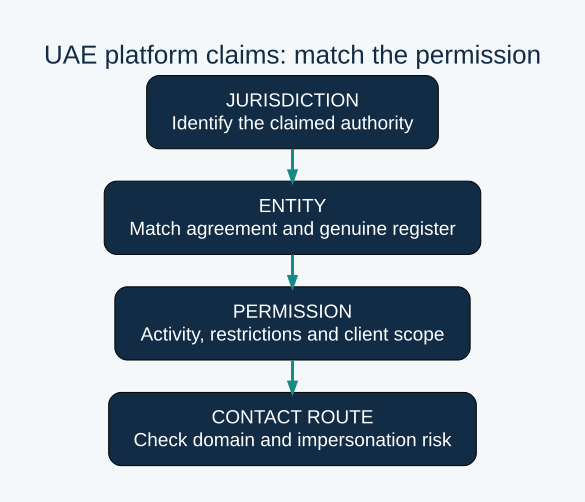
How to check a DFSA or FSRA claim
- Save the legal company name and any reference number in the account agreement.
- Open the genuine authority’s website independently.
- Navigate to its public register and locate the exact entity.
- Read current status, permitted activities, restrictions and client scope where displayed.
- Compare contact information and the actual website used for onboarding.
- Retain the dated record and ask about any mismatch before relying on the claim.
Do not stop at a search-result snippet or the fact that a similar name exists. A record for a parent, partner or differently named company is not automatically the record for the contractual counterparty.
If a register result is unclear, mark the gap explicitly. An unanswered question about scope should not become a green “approved” label in a comparison table.
A convincing register page can itself be fake
DFSA’s February 2025 alert describes cloned public-register pages that looked like the genuine service and even included links back to legitimate pages. It recommends reaching the register from the DFSA website rather than a third-party link.
Check the actual hostname and route, not only the page’s appearance. For example, a lookalike address containing a familiar authority name elsewhere in the URL does not make that authority the site’s owner. A padlock only concerns the connection to the displayed host; it does not settle the business’s identity.
Keep the suspicious URL as evidence without entering credentials or uploading documents there. Verify contact details independently. A caller who says the official record is “out of date” needs an explanation checked through the authority, not blind acceptance.
Three practical examples of permission gaps
An advisory permission used to advertise issuing contracts
Imagine a fictional firm has a record relating to advice, while a promotional website claims it can issue every short-expiry product. The record and the product offer need matching. Do not assume one activity establishes all other activities.
A local group company and an offshore account agreement
A website displays a UAE address, but onboarding names an offshore company. Record that difference and ask which entity actually provides the service, holds funds and handles complaints. The group’s local presence alone does not answer those account-specific questions.
An application milestone presented as full authorisation
A seller announces approval “in principle” and invites immediate funding. Ask for the current final permission and permitted scope. A milestone in an application process is not interchangeable with the completed authorisation record.
Product, customer category and funding route need separate checks
Even after matching the company, inspect the actual contract: payoff, expiry, settlement source and maximum loss. A licence label does not explain the product mechanics or establish that the service is available to every customer.
If a professional or other client category is proposed, ask what it means and what restrictions or protections change. This article does not classify a reader or provide a declaration to bypass retail limits.
A local bank transfer, AED balance or successful small withdrawal is operational evidence. It cannot substitute for the missing permission analysis. Likewise, crypto funding does not change which company contracts with the customer.
Keep a clear licence-check worksheet
| Field | Evidence to retain |
|---|---|
| Claimed jurisdiction | Authority and geographical framework. |
| Contracting entity | Full name, identifier and agreement date. |
| Permission | Current activity wording and restrictions. |
| Customer | Applicable category and stated eligibility. |
| Contact | Genuine register route and verified domain. |
| Unresolved difference | Seller’s explanation and independent confirmation. |
Use separate columns for observations and conclusions. “The company is commercially registered” can be established by one record. “This particular contract is permitted for my account” may require additional evidence.
If the claim remains unresolved or money was already sent
Preserve the agreement, advertisement, licence claim, genuine record and conflicting contact details. Ask the actual institution or relevant authority through independently verified channels about the mismatch.
For a payment dispute, retain request IDs, transfer references and receiving records. Contact the payment institution promptly about suspected fraud or unauthorised activity. A financial-centre address does not guarantee jurisdiction over an unrelated offshore company or automatic compensation.
Secure exposed credentials separately from pursuing a complaint. Do not provide authentication codes, private keys or remote device access to somebody promising a regulator-approved refund.
Frequently asked questions
Does an ADGM commercial licence equal FSRA permission?
No. The reviewed ADGM reminder distinguishes the two records and their roles.
Does a DFSA link supplied by a salesperson prove authenticity?
No. Navigate independently from the genuine authority website; cloned pages are a documented risk.
Does an address in Dubai prove every UAE customer can use a platform?
No. Match the authority, entity, product and customer requirements.
Does this guide certify a particular binary-options product?
No. It provides a permission-checking framework rather than an individual product decision.
Official sources and related research
- DFSA public firms register.
- ADGM FSRA public register.
- ADGM reminder on regulated-status claims.
- DFSA cloned-register warning.
Country research hub · Payment research · Research methodology.
Scope: Checked 24 October 2026. General documentary research, not an exhaustive UAE regulatory map, individual legal advice or funded-account testing.