


A message about a blocked withdrawal or urgent verification can be used to steal account access. Verify the request through a trusted account route before following its link.
Recognise the request, not just the appearance
Phishing can imitate a familiar company’s name, logo and support language. CISA describes it as social engineering that uses deceptive messages or links to obtain access or information.
A well-written message is not necessarily genuine, and a typo is not required for a message to be dangerous. Focus on what the sender wants you to do and whether that request can be verified independently.
Pause when the requested action is unusually sensitive
Examples include entering a password on a new domain, reading out a one-time code, uploading identity documents to an unfamiliar page or installing remote-control software.
These actions can expose different parts of an account. Treat each as a separate decision rather than following a sequence merely because the first message looks familiar.
A verification workflow
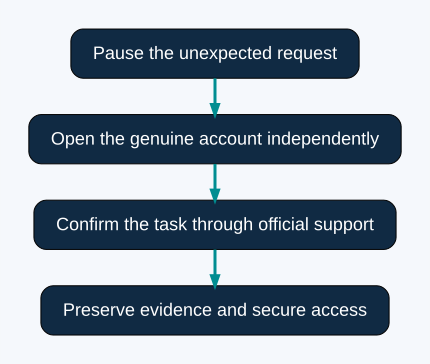
- Keep the message without opening attachments or signing in through its link.
- Open the genuine site from a trusted address.
- Check whether the same task appears inside the account.
- Use the genuine support route to ask about the specific request.
- Preserve the sender details and response.
Do not use the phone number supplied in the suspicious message as the only verification channel.
Inspect domains carefully
A subdomain, lookalike spelling or misleading link label can disguise the destination. The visible company name in a message does not establish who controls the linked site.
HTTPS protects a connection to the site you reached; it does not certify that the site is the intended broker. An attacker can also obtain an encrypted connection for a deceptive domain.
If information was already entered
Use a trusted route to change exposed credentials and review active sessions. Secure the email account if it shares the password or controls recovery. If payment details or identity records were exposed, contact the relevant genuine provider about the next steps.
Preserve the message, destination address, approximate times and actions taken. This record helps distinguish a credential incident from a later unauthorised transaction.
Report the message without amplifying it
Use the provider’s genuine reporting process and the appropriate email or platform abuse controls. If sharing an example publicly, remove personal identifiers and do not turn the malicious link into a clickable recommendation.
A security incident does not need to be solved through a stranger offering account recovery for a payment. Keep recovery activity within verified channels.
Three trading-account messages to verify independently
“Your withdrawal will expire unless you verify now.” An urgent deadline can pressure a reader into opening a supplied link. Open the genuine account independently and check the withdrawal record. If the request is not explained there, ask official support about the exact transaction. An authentic pending withdrawal does not authenticate every message that mentions it.
“Upload your identity documents to this new portal.” Identity verification can be a genuine account requirement, but the destination still needs verification. Ask which legal entity requests the document, what secure upload route applies and whether the same task appears inside the trusted account. Avoid sending full documents to an unsolicited messaging profile.
“Read out the code so we can remove a restriction.” A current login or approval code can authorise access rather than merely identify you. Do not disclose it to a caller or chat contact. Verify the request through an independent support route. No amount of familiarity with a broker logo makes the requested secret harmless.
Domain examples: read the actual destination
These reserved example domains are illustrations, not real broker addresses. In broker.example, the name is directly under the reserved example domain. In broker.example.attacker.invalid, the familiar-looking words sit inside a different hostname ending in attacker.invalid. Adding a familiar word at the beginning does not make the destination belong to that organisation.
A label reading “Official Account” can point somewhere else. Shortened links, QR codes and attachments can also obscure the destination. You do not need to open an uncertain link to prove it is dangerous: independently open the genuine service instead. Treat domain inspection as one check, not a complete guarantee of authenticity.
Match the response to what happened
| Exposure | Useful next action |
|---|---|
| Message received only | Preserve it and verify independently before acting |
| Link opened | Close the page; check for downloads and keep software updated |
| Password entered | Change it through the genuine service from a trusted device and review sessions |
| Code or approval supplied | Treat account access as potentially exposed; use official security and recovery controls |
| Money sent | Contact the payment provider promptly with transaction references |
Opening a link does not by itself prove that money was stolen, and seeing no immediate loss does not prove the page was safe. If software was downloaded or run, use updated security tools and reputable technical assistance as appropriate. Keep the sequence of events clear so support can assess the actual exposure.
Preserve a useful incident timeline
Record the received time, sender address or profile, claimed organisation, message subject, destination address and actions you took. Save original messages where possible, rather than retaining only a cropped image. Note any genuine account alerts and transaction references separately.
Do not upload authentication secrets to a public link scanner or public forum. URLs can contain account tokens or personal identifiers. When sharing an example for education, redact sensitive information and display suspicious addresses as non-clickable text. The aim is to document the incident without creating another disclosure.
Frequently asked questions
Does a padlock prove a broker message is genuine?
No. An encrypted connection does not establish that the destination is the intended organisation. Verify the domain and the request through independently established channels.
Is a message safe because it uses my name?
No. Personalisation may come from public records, prior communications or exposed data. It does not establish who controls the sender’s account.
Can a real support conversation still contain a suspicious request?
Assess each sensitive action independently. A previous genuine exchange does not remove the need to verify a new payment destination, document portal or access request.
Where should I report it?
Use the genuine provider’s security channel, the messaging service’s reporting function and the appropriate reporting body for your location. FTC guidance is a US resource; local reporting routes vary. Preserve payment evidence using our payment research guides and review our account-security research.
Sources and research scope
Public-source review: 24 October 2026. Examples are illustrative. Documentary research does not represent funded-account testing. Rules must be checked against the current product, entity and customer location.
Related research
Account security research · Research methodology · Calculation tools
Risk: Fixed-outcome contracts can lose the entire stake. No chart pattern, calculator or demo result guarantees future returns.