


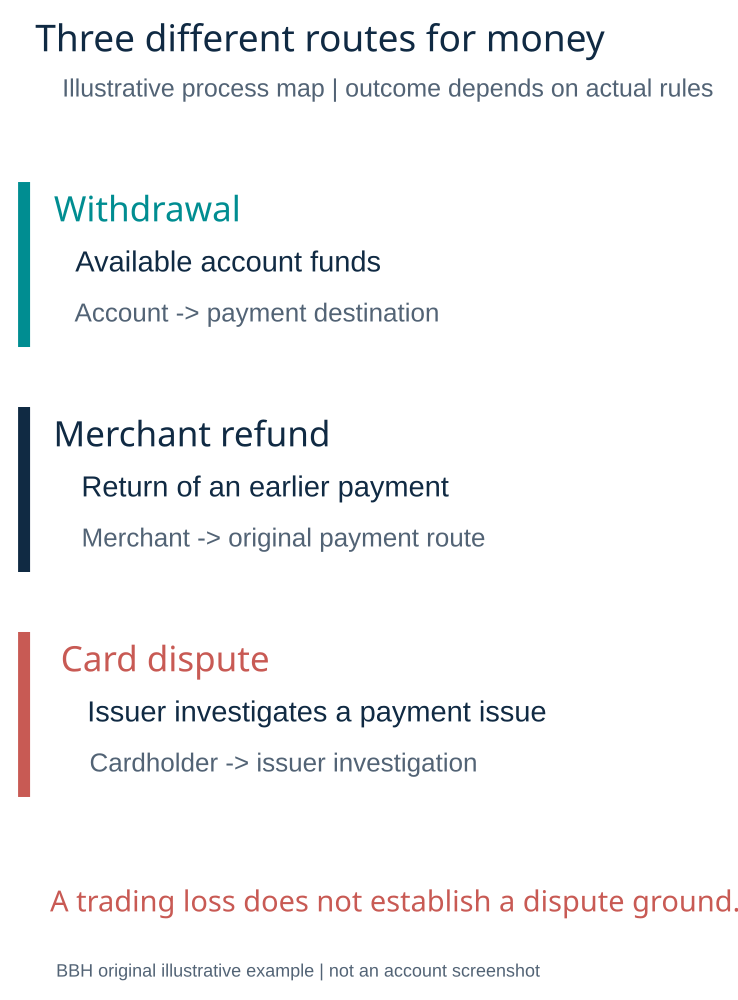
A withdrawal, merchant refund and card dispute are different processes. Identify what actually happened and which payment rules apply before assuming one route guarantees money back.
Separate the three actions
A withdrawal requests available funds from an account. A refund asks the recipient or merchant to reverse or return a payment under the relevant terms. A card dispute asks the issuer to investigate an eligible payment problem.
A losing contract is not automatically an unauthorised charge or a valid chargeback reason. Describe the facts accurately instead of selecting whichever label sounds most likely to produce a refund.
Jurisdiction and payment type matter
US CFPB guidance explains card billing-error and purchase-dispute processes, including particular notice requirements. Those rules should not be copied as worldwide deadlines for every debit card, bank transfer or crypto transaction.
Ask the actual issuer or payment provider about the applicable process and act promptly. A platform support conversation does not necessarily preserve a separate payment-dispute deadline.
A useful evidence comparison
| Process | Core evidence |
|---|---|
| Withdrawal | Account balance, request and release records |
| Refund request | Original payment, terms and reason for reversal |
| Card dispute | Statement entry, factual issue and issuer requirements |
The same original payment can be relevant to more than one process, but duplicate recovery should not be concealed.
Use an honest chronology
Record authorisation, payment, account credit, any trading activity, refund or withdrawal request and support replies. Preserve both the original transaction and later credits.
For example, if a deposit was authorised and credited but a later withdrawal was delayed, do not report the original deposit as unrecognised. The complaint should explain the actual later problem.
Avoid guaranteed-recovery claims
An issuer can assess eligibility and evidence, but a dispute is not a promise that every financial loss will be reversed. Temporary credits, where applicable, should not be presented as a final decision before the process ends.
Do not fabricate screenshots, hide material activity or use a paid script that instructs you to make a false claim. That can undermine a legitimate complaint.
Keep the next step specific
Ask the merchant for a written response and contact the relevant payment provider about its own process. Retain submission dates, case numbers and decisions.
If legal advice is needed, seek advice appropriate to the transaction and jurisdiction. This article explains distinctions and evidence organisation; it does not determine an individual right to reimbursement.
A practical dispute file: separate amounts from claims
Build one chronological file before writing a complaint. This worksheet organises facts; it does not establish eligibility or tell an issuer which dispute category to accept. Keep the amount deposited, the amount traded, the amount requested for withdrawal and the amount actually returned in separate columns. An account balance is not a card-statement credit.
| Record | What to capture | Why it helps |
|---|---|---|
| Original payment | Date, currency, amount, merchant descriptor and reference | Identifies the transaction being investigated |
| Account activity | Credit entry, trade history and balance changes | Distinguishes payment delivery from later events |
| Requested remedy | Specific factual problem and amount in question | Avoids treating every loss as the same claim |
| Later credits | Merchant refund, issuer credit and final outcome | Prevents double counting |
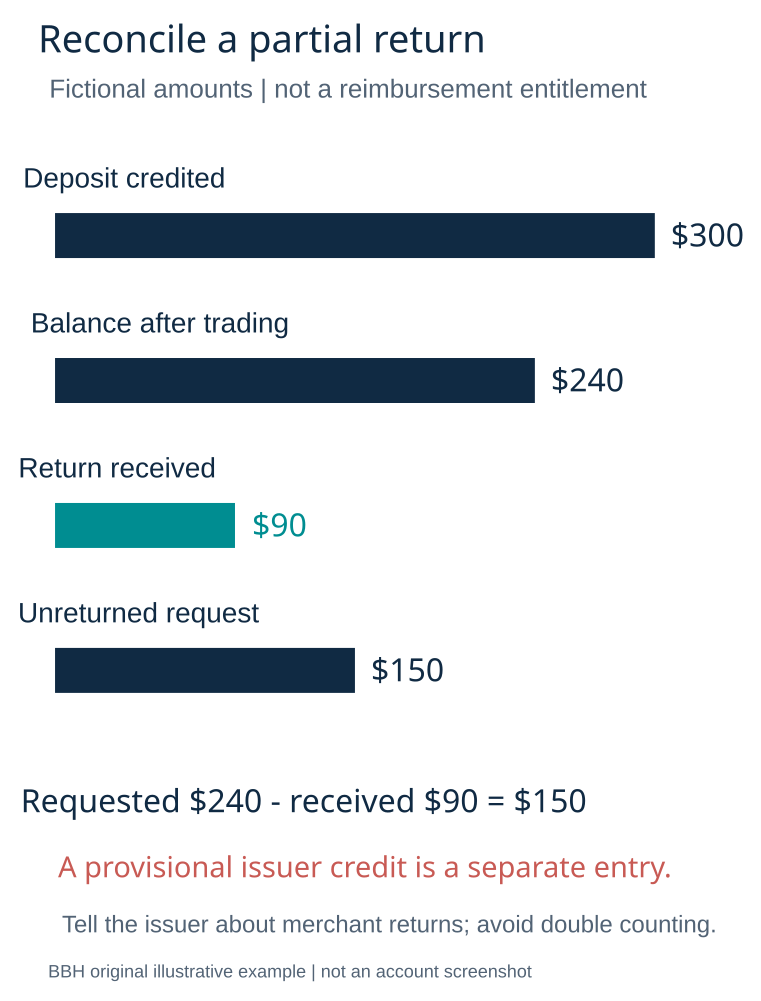
Worked example: a partial return
Suppose an authorised deposit of $300 was credited to an account. Trading subsequently reduced the balance to $240. The customer requested that $240, and a $90 return later reached the original payment account. The withdrawal reconciliation is $240 − $90 = $150 outstanding, assuming there were no other adjustments. The $60 trading loss remains a separate event. This arithmetic does not establish that $150 is recoverable through a card dispute.
If the issuer also shows a provisional $150 credit, record it separately and tell the issuer about the $90 merchant return. Do not call a temporary credit a final recovery. Ask whether any adjustment is needed and retain the written decision. Currency conversions can make statement amounts differ, so reconcile in each original currency before calculating a converted total.
Ask about deadlines without assuming a universal clock
The CFPB’s US credit-card billing-error guidance describes calling promptly and sending a written notice within 60 calendar days after the charge appeared on the statement. That is a particular US framework, not a worldwide chargeback deadline. It also distinguishes other purchase disputes. Ask your issuer which process, notice address, documents and time limit apply to the facts. Do not assume a merchant’s investigation pauses that limit.
- Identify the issuer through your statement, card or authenticated banking application.
- Explain whether the issue concerns authorisation, duplicate billing, delivery, a promised refund or a later account restriction.
- Ask how to submit evidence and obtain a case reference.
- Record the deadline and any additional document request.
- Update the file when either party returns money or issues a decision.
Recovery offers require a separate check
The FTC warns that people who have lost money may be targeted again by unsolicited recovery offers demanding payment upfront. Someone knowing your previous loss amount does not prove they represent an issuer, regulator or law firm. Verify an organisation independently before sharing records. An unexpected “release tax” or payment to a private crypto address is not evidence that recovered funds exist.
Use the site’s deposit and withdrawal research to organise the operational issue, and its research methodology to distinguish documentary findings from actual account testing.
Refund and chargeback FAQs
Can I dispute a deposit I authorised?
Tell the issuer that you authorised it and explain the actual problem. Authorisation and other dispute grounds are different questions; the issuer must assess whether an applicable route exists.
Does a broker’s refund refusal decide my legal rights?
A merchant’s response does not itself determine every right under local law or your payment agreement. Preserve the response and ask the issuer or an appropriate adviser about the applicable process.
Should I stop keeping records after receiving a credit?
No. Retain the credit entry, case correspondence and final decision. If the merchant also pays, disclose that return so the outstanding amount can be reconciled accurately.
Sources and research scope
- CFPB: disputing a credit-card charge, US framework
- CFPB: refunds and card disputes, US framework
- FTC: refund and recovery scam warnings
Public-source review: 25 October 2026. Examples are illustrative. Documentary research does not represent funded-account testing. Rules must be checked against the current product, entity and customer location.
Related research
Payment dispute research · Research methodology · Calculation tools
Risk: Fixed-outcome contracts can lose the entire stake. No chart pattern, calculator or demo result guarantees future returns.