


We may earn a commission through these partner links. Demo funds are virtual; access and country eligibility depend on the platform terms. Disclosure
A marker shown on a historical chart may not have been visible at that moment in real time. Evaluate when the information became available, not only where the final chart places it.
Repainting has more than one cause
TradingView’s documentation distinguishes historical-versus-realtime behaviour, plotting into the past and dataset changes. Not every moving live value is deception; an unfinished candle naturally changes.
The important research question is whether the displayed history accurately represents what a user could have observed and acted on at each decision time.
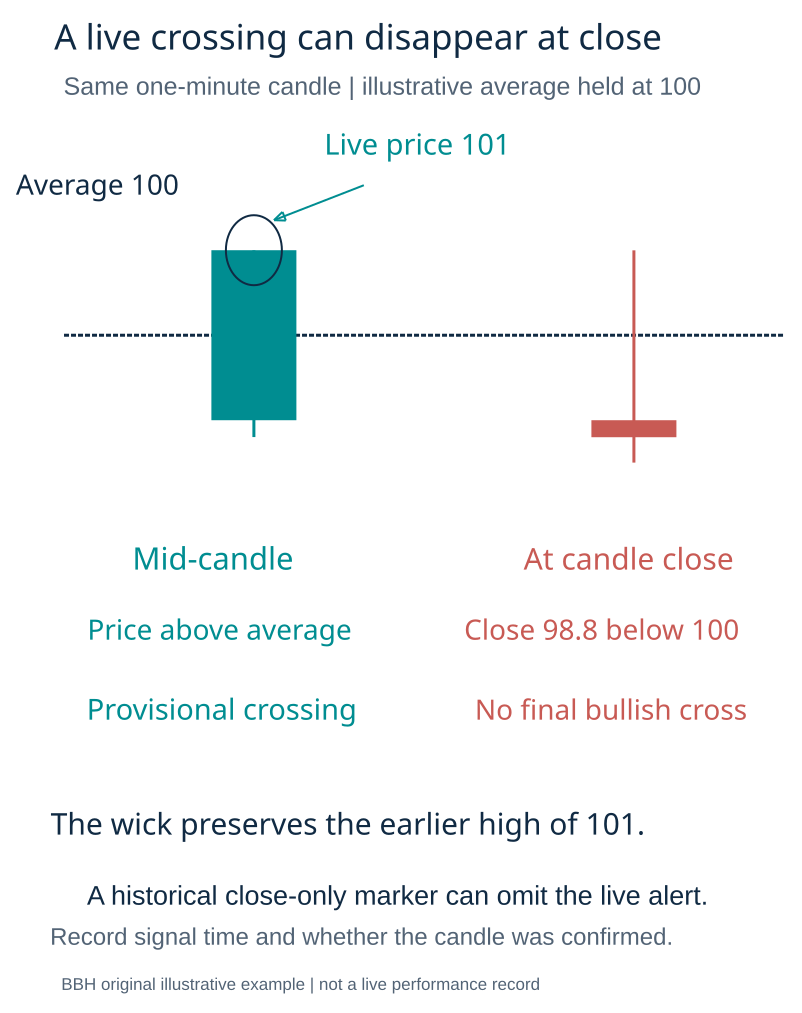
A live crossing can disappear
Suppose price crosses an average midway through a candle, then closes below it. An intrabar alert could have occurred even though the completed historical candle shows no final crossing.
A rule that waits for confirmation answers a different timing question from one that acts immediately. Neither should be evaluated using the other’s historical event count.
A past marker may be confirmed later
Imagine a swing definition requiring three later bars to confirm a high. Plotting the marker on the high’s original bar can be visually useful, but the information was not available until those later bars existed.
A backtest entering at the original high because the marker is drawn there uses unavailable information unless another independent rule could have identified that entry then.
Check the availability timeline
| Feature | Question |
|---|---|
| Live signal | Can it change before close? |
| Confirmed marker | When was it actually confirmed? |
| Higher-timeframe data | Was the final value known at entry? |
| Historical revision | Did the input dataset change? |
| Alert record | Does it match the decision-time state? |
Look-ahead is an information problem
If a rule uses the final high of a period before that period ends, it accesses future information in the historical model. A configuration setting that leaks higher-timeframe data can create the same issue.
Avoid copying a technical setting without understanding its data timing. The appropriate implementation depends on the intended behaviour; one switch is not a universal remedy.
Evaluate with preserved observations
Keep alert timestamps, screenshots or logs from the original observation period, then compare them with the later historical display. Ask the script author to explain confirmation, offsets and data requests.
Do not accuse every changing indicator of fraud. Describe the exact mismatch and its consequence for the test. A non-repainting claim is not enough without a defined meaning and evidence.
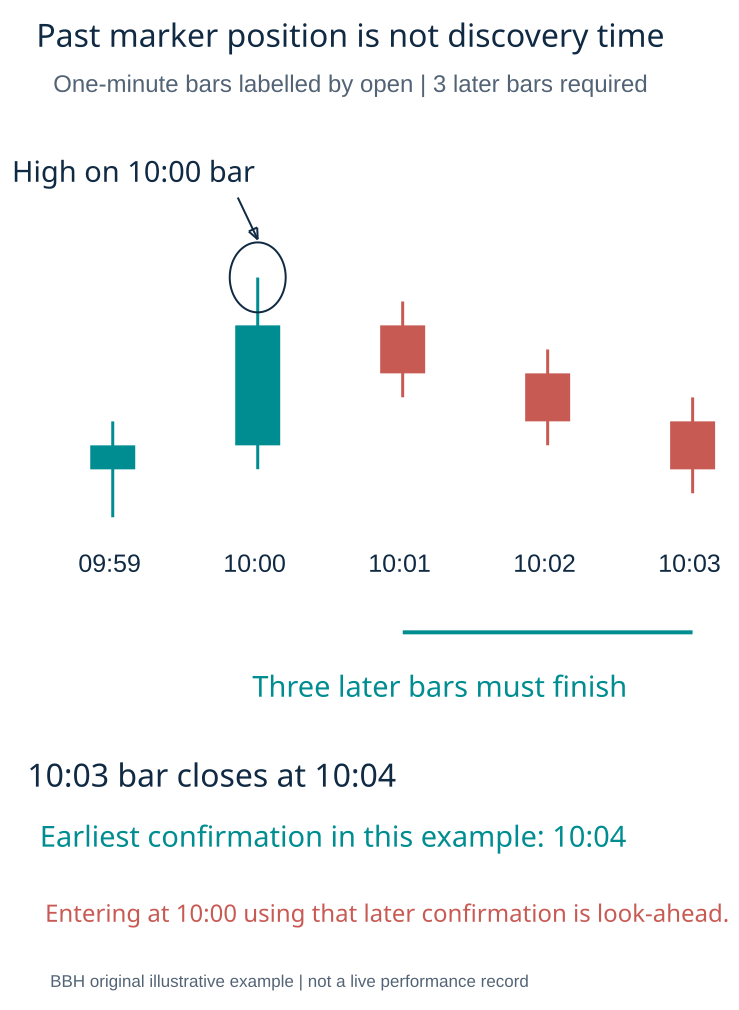
Worked timeline: a confirmed pivot is known later
Imagine consecutive one-minute bars labelled by their opening times. A possible high forms on the 10:00 bar, and a hypothetical pivot rule requires the next three completed bars to confirm it. The 10:01, 10:02 and 10:03 bars must finish first. Confirmation is therefore available at 10:04, assuming those bars support the rule. A marker drawn back on 10:00 does not move that knowledge back four minutes.
| Time | Information available | Valid research description |
|---|---|---|
| 10:00 bar forming | Price still changes | Possible high; not confirmed |
| 10:01–10:03 bars forming | Later evidence incomplete | Pivot test still pending |
| 10:04 | Three later bars completed | Confirmation can first be evaluated |
| Later historical display | Marker may appear at 10:00 | Plot location differs from discovery time |
The example defines its own timing convention. A real script may use another number of bars or another confirmation rule. Record both the bar being described and the time the signal first became observable. Execution must be modelled after the relevant information exists, using the actual intended entry convention.
Higher-timeframe confirmation has a separate clock
A five-minute chart can contain a completed five-minute candle while the one-hour candle used by its indicator is still forming. Waiting for the smaller candle to close does not by itself confirm that hourly input. Ask whether the script uses a developing higher-timeframe value or a previously confirmed value, and what delay that choice introduces.
A request setting is meaningful only alongside its expression, offsets and intended timing. Do not change a lookahead switch in isolation and assume the historical test is repaired. Review the data request and compare its decision-time values with preserved realtime observations.
Keep a decision-time evidence log
- Record script version, settings, exact symbol, chart type and timeframe.
- Preserve the alert time, received time and the signal’s provisional or confirmed status.
- Capture the information used at that time, including any higher-timeframe input.
- After the relevant bars close, save the resulting chart without overwriting the original record.
- Reload later and document differences in markers, values or alerts.
Keep data corrections and setting changes separate from calculation changes. A changed symbol feed, session definition or script version means two screenshots may not describe the same experiment. A screenshot alone may also omit the input state needed to reproduce an alert.
Measure the mismatch before interpreting accuracy
Suppose a forward observation log contains 20 original alerts. On a later chart, 12 still have matching markers and eight do not. The marker-retention rate is 12/20 = 60%; it is not a win rate. The eight original alerts still belong in the decision-time sample if they met the study’s predefined inclusion rule. Deleting them because the final chart looks cleaner changes the sample after the outcome.
Separately evaluate what each original alert would have meant under the frozen entry, expiry and payout rules. Report missing execution evidence rather than inventing an entry price from the later chart. A confirmed signal may be reproducible and still unprofitable.
Use the indicator research academy and research methodology to distinguish explanation, historical simulation and actual forward observation.
Repainting indicator FAQs
Does bar-close confirmation solve every repainting problem?
No. It addresses the intended chart-bar timing but does not automatically fix later confirmation, higher-timeframe inputs, future leakage or revised datasets.
Does non-repainting mean accurate?
No. Stable historical markers do not establish predictive ability, acceptable exposure or positive net returns.
Is replay identical to a saved live alert log?
Do not assume so. Establish what data and intrabar states the replay actually reconstructs before treating it as equivalent evidence.
Sources and research scope
Public-source review: 25 October 2026. Examples are illustrative. Documentary research does not represent funded-account testing. Rules must be checked against the current product, entity and customer location.
Related research
Indicator research academy · Research methodology · Calculation tools
Risk: Fixed-outcome contracts can lose the entire stake. No chart pattern, calculator or demo result guarantees future returns.