


We may earn a commission through these partner links. Demo funds are virtual; access and country eligibility depend on the platform terms. Disclosure
An arithmetic average describes the mean of individual percentage changes. Compound return describes what sequential changes do to a starting amount. These are different summaries.
Multiply sequential growth factors
For returns r1 through rn without external cash flows, ending value divided by starting value is the product of (1 + ri). Total compound return is that product minus one.
Do not add percentage returns and label the result account growth. Each later percentage applies to the amount remaining at that point.
An original two-period example
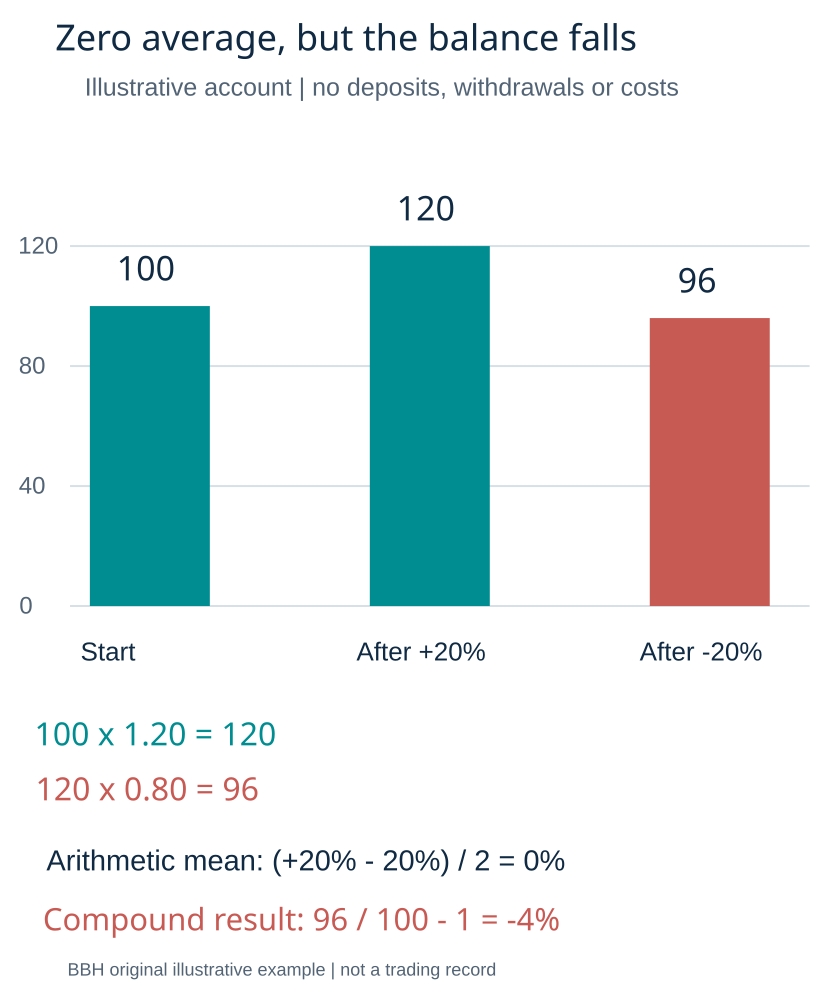
A 20% gain followed by a 20% loss changes 100 into 120 and then 96. The arithmetic average is zero, but the compound result is −4%.
The geometric average per period is the square root of 1.2 × 0.8 minus one, approximately −2.02%. Over two equal-length periods, that constant rate reproduces the same ending value.
Compare the summaries
| Measure | Example result | Question answered |
|---|---|---|
| Arithmetic average | 0% | Mean of the two listed percentages |
| Total compound return | −4% | Overall change in the account amount |
| Geometric average | About −2.02% | Constant equal-period rate with the same ending value |
Separate percentage returns from stake outcomes
A fixed-outcome contract’s 80% profit payout is a percentage of its stake, not necessarily a percentage return on the whole account. Translating it into account return requires the stake fraction.
For an illustrative two-unit stake from a 100-unit account, an 80% winning profit adds 1.6 units, or 1.6% of the starting account before other changes. Calling it an 80% account gain would be false.
External cash flows complicate the picture
A new deposit can increase the ending balance without creating a trading return. A withdrawal can lower the balance without representing a loss.
Keep contributions and withdrawals separate. Use an explicitly defined performance method when comparing accounts with cash flows instead of forcing all changes into a simple start-to-end percentage.
Read promotional averages carefully
Ask whether a claim is a per-trade payout, average observation result, account growth or annualised statistic. Require the period lengths, full sequence, costs and cash-flow treatment.
A positive average from selected winners does not establish a positive compound result. Historical summaries also do not guarantee that future returns will follow the same sequence or distribution.
A positive average can coexist with a loss
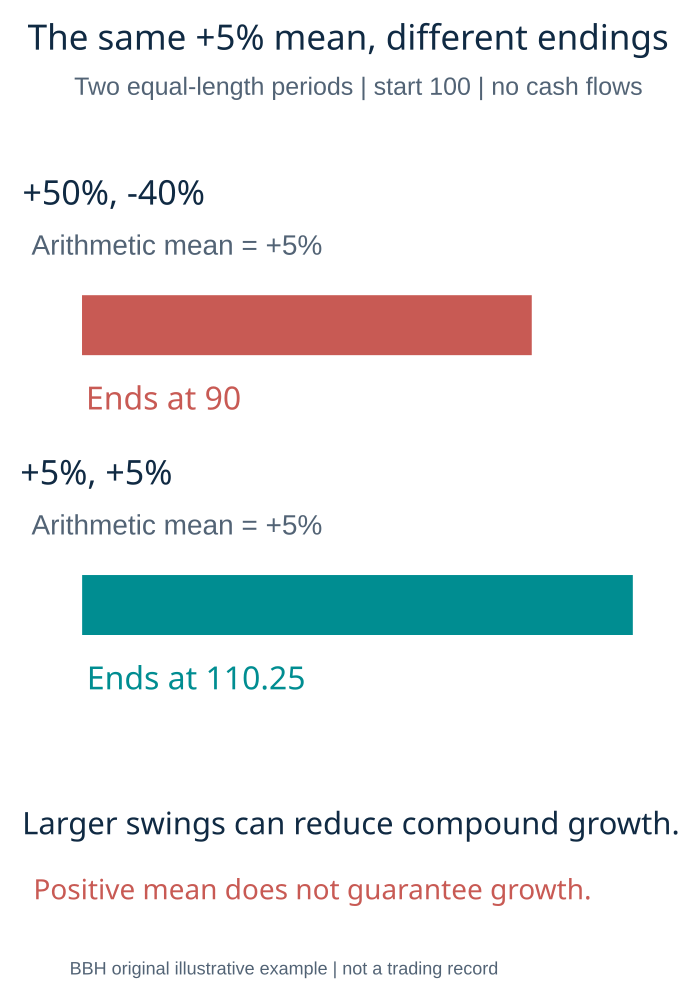
Consider two invented equal-length periods with returns of plus 50% and minus 40%. Their arithmetic average is plus 5%. Starting from 100, the account rises to 150 and then falls to 90. Its total compound return is minus 10%, despite the positive arithmetic mean.
By contrast, two periods earning exactly 5% each would grow 100 to 110.25, a gain of 10.25%. Substituting an arithmetic mean for a variable realised sequence therefore creates a different path and ending amount. The comparison is arithmetic, not a forecast of achievable returns.
| Illustrative sequence | Arithmetic mean | Ending value from 100 |
|---|---|---|
| +20%, −20% | 0% | 96 |
| +50%, −40% | +5% | 90 |
| +5%, +5% | +5% | 110.25 |
Keep stake return and account return separate
A profit payout quoted for a fixed-outcome contract applies to the stake under the specified terms. If a fictional account commits 2% of its current balance to a contract with an 80% net winning payout, a win adds 1.6% of that balance while a full-stake loss removes 2%, before other changes.
Those percentages do not promise a sequence of wins. Constant percentage-of-balance exposure also differs from a constant currency stake: the amounts at risk change with the account. A compounding worksheet must state which convention it models.
Recovery percentages use a smaller base
A fictional 40% decline takes 100 to 60. Returning from 60 to 100 requires a gain of 40 divided by 60, approximately 66.67%. The required gain is not 40%, because it applies to the reduced amount.
This calculation describes the size of a recovery; it is not a plan for producing it. A larger stake or a more ambitious target does not create the expected return needed to reverse a loss. Keep the mathematics separate from any proposed action.
A calculator’s assumed rate is an input
Investor.gov’s compound-interest calculator asks for an estimated annual rate, time, contribution amount and compounding frequency. Such a calculation can explore assumptions. It does not establish that a trading strategy will deliver the entered rate.
Compounding interest at a specified rate and reinvesting variable trading outcomes are different models. If a projection assumes the same return every day, label that assumption explicitly. Do not describe a smooth projection as a prediction merely because a calculator produces it accurately.
Cash-flow timing and order need context
Without external cash flows, multiplying the same return factors in a different order gives the same final value. The interim drawdown can still differ. When deposits or withdrawals occur between periods, changing the timing can also change the amount exposed to subsequent returns.
Preserve each cash flow’s date and amount. An account that grows after a deposit has not necessarily earned that growth. Before comparing accounts, choose a defined performance method and retain the original ledger so another reader can reconstruct it.
Use a transparent reporting worksheet
- Identify whether each percentage applies to stake, account balance or another denominator.
- Record the period length and complete sequence.
- Separate contributions and withdrawals from gains and losses.
- Include applicable costs and documented payoff assumptions.
- Calculate total growth and label any equal-period geometric average.
- Distinguish historical results from assumed future scenarios.
Do not annualise a short selected winning run without explaining the repeated-return assumption. A precise annualised number can conceal a highly uncertain underlying process.
Frequently asked questions
Can positive average returns still lose money?
Yes. The plus 50%, minus 40% example has a positive arithmetic mean but a negative compound result.
Does an 80% payout mean the account grows 80%?
No. Translate the net stake payoff into account impact using the actual stake fraction and contract terms.
Does reversing the same return sequence change its final value?
Without external cash flows or other changes, no. It can change the interim balance path. Cash-flow timing requires separate analysis.
What does a compound calculator prove?
It can verify the result of stated inputs, not the likelihood of achieving them. Our calculation tools and research methodology keep those roles separate.
Sources and research scope
- BBH calculation methodology
- Investor.gov: compound-interest calculator inputs
- Investor.gov: compound-interest definition
Public-source review: 25 October 2026. Examples are illustrative. Documentary research does not represent funded-account testing. Rules must be checked against the current product, entity and customer location.
Related research
Performance calculation tools · Research methodology · Calculation tools
Risk: Fixed-outcome contracts can lose the entire stake. No chart pattern, calculator or demo result guarantees future returns.