


We may earn a commission through these partner links. Demo funds are virtual; access and country eligibility depend on the platform terms. Disclosure
A binary-options demo journal should preserve what was known before the result and what the accepted record showed afterward. Its purpose is reproducible learning, not a collection of winning screenshots. Keep virtual activity, rule development and evaluation clearly identified.
Research checked 23 October 2026. Example records are invented and use virtual funds. This article is a journal design guide, not evidence of strategy profitability.
Start with one question the journal can answer
Choose a narrow objective such as checking the difference between candle close and contract expiry, reproducing an indicator setting or counting a fixed candle definition in one session. Write the question before collecting observations.
Interface practice and strategy evaluation need different evidence. Learning where the expiry selector is located does not require a profitability claim. Evaluating a rule requires a definition, inclusion criteria and outcomes gathered without changing the rules after seeing results.
A demo also does not test withdrawal processing or establish live execution equivalence. Label the environment prominently so virtual records cannot later be presented as real-money payment evidence.
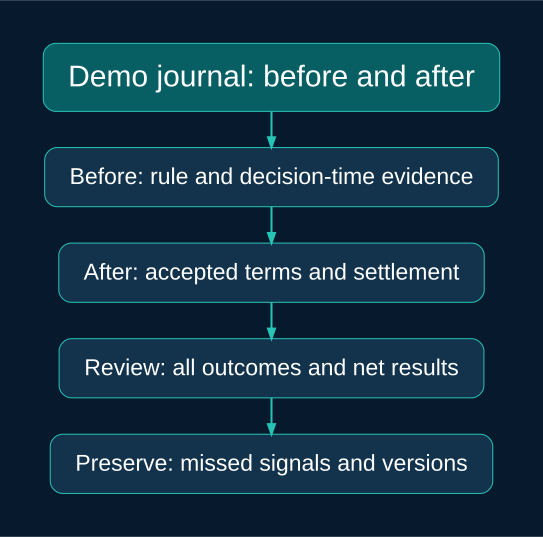
Time, symbol, rule and planned expiry
Record accepted terms if available
Add result, corrections and missing fields
Illustrative journal layout; not an actual account record.
Essential binary-options trading journal fields
| Field | What to preserve | Purpose |
|---|---|---|
| Observation ID | Unique local reference | Links notes, files and outcome |
| Environment | Demo platform and account currency | Prevents mixing evidence types |
| Instrument | Full symbol and source, including OTC | Identifies the series studied |
| Time | Date, timestamp and timezone | Aligns decision and records |
| Rule version | Definition fixed before the observation | Preserves what was actually tested |
| Chart state | Interval, settings and completed/forming bar | Shows available information |
| Entry and expiry | Accepted quote and timestamps | Defines the contract comparison |
| Money fields | Virtual stake, accepted payout and credit | Enables net-result reconciliation |
| Outcome | Win, loss, refund, adjustment or unresolved | Retains all categories |
| Exception | Missing information or deviation | Makes limitations visible |
Use separate fields for requested and accepted terms when both are available. A screenshot taken before clicking does not establish the final accepted entry or return. Preserve the transaction identifier returned by the platform.
Before the result: record the decision state
Write the observed condition, the rule version and whether it qualifies. Save a decision-time screenshot with the full symbol visible. Record a planned horizon as a plan, not as a completed transaction.
If a rule uses a completed candle, preserve its completion time. If it uses a live indicator reading, save that reading and timestamp. The final historical indicator value may not reconstruct a temporary intrabar state.
Do not write “entered at the low” after seeing the later candle. A historical extreme is not evidence that an order could have been accepted there. The journal should expose timing assumptions instead of smoothing them away.
After the result: append rather than rewrite
Add the accepted transaction record, settlement value where available and actual virtual credit. Keep earlier notes intact. If an initial note was wrong, add a correction with a reason rather than silently replacing it.
An unclear result should remain unresolved until supported. Ask which missing field prevents evaluation: expiry quote, timezone, accepted payout or another term. Avoid assigning a win because a later screenshot looks favourable.
A complete illustrative demo entry
Consider observation D-001, recorded in a demo environment on a fully labelled hypothetical instrument. The learning question is whether a 60-second elapsed contract ends at the current M1 candle close.
- Chart: M1 candle begins at 10:00:00 UTC.
- Accepted entry: 10:00:35 UTC at 100.00.
- Accepted expiry: 10:01:35 UTC.
- Virtual terms: one-unit stake and 80% net profit payout.
- Illustrative settlement: 99.99, with zero credit under the example’s loss rule.
- Net result: −1 virtual unit.
The timing observation is that the contract spans parts of two candles. That learning result remains valid even though the illustrative contract loses. A journal focused only on wins would miss the actual objective.
Log missed signals, skips and exclusions separately
If an event qualified but was not entered, label it as a missed qualifying observation. Do not invent an accepted entry. It may belong in a signal-study dataset while remaining outside the executed-contract ledger.
If an event did not qualify, record the predefined reason. Keep discretionary skips separate from rule-based exclusions. Otherwise a study can quietly remove losing events while retaining similar winning ones.
A useful status list is: qualified and entered; qualified but missed; did not qualify; excluded under a stated rule; unresolved due to missing data. Define these categories before reviewing their outcomes.
Review arithmetic and process at a fixed point
At a predefined review date or observation count, total wins, losses, refunds and unresolved cases. State the win-rate denominator. Then calculate each net result from its own virtual stake, accepted return and credit.
Ten one-unit wins at 80% net payout and ten full losses produce 8 − 10 = −2 units. A 50% decided-outcome win rate does not offset unequal rewards and losses. Variable stakes and returns require row-by-row calculations.
Review execution deviations separately from price outcomes. A profitable example can still violate the stated rule; a losing example can follow it correctly. Keep process adherence and financial result in different fields.
Preserve rule versions and evaluation data
Create V2 when a definition changes. Do not relabel V1’s losing observations as never qualifying under a filter invented later. Preserve the reason and date of the change, then evaluate the new version on unused observations.
TradingView’s official strategy documentation discusses selection bias, overfitting and future-data leakage. A manual journal can encounter comparable evidence problems even though its platform and execution mechanics differ.
Keep development, evaluation and interface-practice records labelled. Repeatedly checking the evaluation results to choose new rules makes those observations part of development.
Evidence files, privacy and balance resets
Use stable filenames linked to observation IDs. Retain original screenshots privately and make separate redacted copies for sharing. Remove credentials, payment identifiers and unrelated personal information from public copies.
If the demo balance is reset, record the reset as a separate event. Do not treat the added virtual balance as recovered profit. A complete history should retain the losses before the reset.
Pause the exercise if repeated resets or attempts to erase losses replace the original learning question. More observations are useful only when they remain consistently defined and honestly recorded.
Frequently asked questions
Is a screenshot folder enough?
It can preserve evidence, but needs identifiers, timestamps, inclusion rules and a reconciled ledger to become a reproducible journal.
Should missed signals count as live trades?
No. Keep hypothetical signal outcomes separate from accepted transactions.
Can demo success prove live profitability?
No. It does not establish real execution, withdrawal reliability or a stable future outcome probability.
Sources and further learning
The linked documentation supports the attributed testing-bias concepts. The journal structure and examples are editorial guidance. Continue with our demo learning hub, chart comparison guide, tools and methodology.
Risk: Real-money fixed-outcome contracts can lose the full stake. A demo journal is a learning record, not a guarantee of profitable trading.