


For UK retail binary-options research, start with the FCA prohibition rather than an offshore broker ranking. A registration form accepting a UK address does not establish that the product can be sold to you.
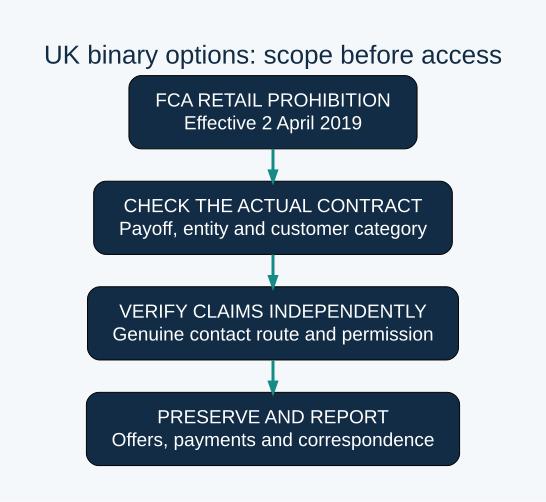
The FCA’s 2019 announcement prohibits firms acting in or from the UK from selling, marketing or distributing binary options to retail consumers. The permanent rules took effect on 2 April 2019 and include securitised binary options. Its current consumer guidance continues to warn about offers made after the ban. Sources checked: 24 October 2026.
Read publication, effective and review dates separately
The announcement was published on 29 March 2019; the effective date was 2 April 2019. Those are different events. A later website review date tells you when an author checked a source, not when the rule first began.
Older material can describe an earlier regulatory framework accurately while giving the wrong impression about a current offer. Do not select a historical sentence about supervision and omit the later product prohibition.
For any legal update, keep a short evidence ledger: source title, issuing authority, publication date, effective date, scope and date checked. If a later amendment is claimed, find the official instrument or announcement rather than relying on a broker’s marketing summary.
“FCA authorised” does not answer every product question
Separate the identity of the firm from the service being offered. A real company name in a register does not demonstrate that a particular website or caller belongs to it. Nor does a general authorisation claim answer whether the specific offer fits the applicable product and customer restrictions.
The FCA’s clone-firm guidance describes impersonators copying names, addresses and reference numbers. It recommends matching the firm’s permitted service and contact details through its checking tools. Use independently obtained contact information rather than the number supplied in an unsolicited message.
| Claim | Evidence to request or preserve | Unresolved question |
|---|---|---|
| “FCA authorised” | Exact entity and genuine record. | Does the contact route match that firm? |
| “UK clients accepted” | Dated offer and targeting details. | What supports permission for the actual product? |
| “International licence” | Issuing authority, entity and scope. | What does it establish about this UK offer? |
| “Professional account available” | Classification explanation and terms. | Has eligibility been properly assessed? |
Do not change an address or customer declaration simply to get through onboarding. An accepted registration is not a legal opinion. If an unusual classification is proposed, obtain advice specific to the arrangement before relying on a salesperson’s description.
Digital, fixed return, OTC and AI are labels to investigate
Ask what the contract actually pays, what event determines the outcome, when it expires and how much can be lost. A different name does not by itself determine regulatory classification.
For example, a fictional app calls its offer an “AI fixed-return prediction”. If the payout depends on whether a price is above a threshold at expiry, the marketing name leaves the important contract questions unanswered. Preserve the specification and ask for the basis of any claim that the restriction does not apply.
“OTC” also needs context. It can describe a market structure or be a broker’s asset label; neither meaning establishes permission. Compare legal and product evidence rather than inferring a regulatory category from an instrument suffix.
Why payouts and minimum deposits cannot settle the UK question
Imagine a comparison table ranks three platforms by deposit minimum, advertised payout and number of assets. Even if each number was copied correctly, the table has not addressed the retail prohibition. Operational features cannot replace the missing product-permission analysis.
The same applies to an app-store listing, a demo balance or a successful small payment. Each demonstrates a narrow fact. None establishes that an offer is permitted for a UK retail consumer.
Our country research therefore explains the documented restriction and how to inspect a claim. It does not present a “best UK binary brokers” recommendation or instructions for bypassing a location block.
A practical checklist for a UK-facing offer
- Preserve the advertisement, full domain, date and the way you were contacted.
- Record the exact legal entity and contract specification.
- Compare the product and customer scope with current official guidance.
- Check any authorisation claim through the genuine authority’s route.
- Match contact details independently and retain discrepancies.
- Keep unanswered questions visible instead of treating a sales reply as verification.
A useful research note says what is established and what remains unsupported. “The website accepts a UK telephone number” is a valid observation. “Therefore it is approved for UK retail binary options” is an inference that the observation cannot support.
If money, documents or login details were already sent
Preserve payment references, account history, communications, document requests and the advertised entity. Use a trusted device or route to secure exposed credentials and contact the relevant payment institution promptly about suspected fraud or unauthorised activity.
The FCA consumer page directs people to its genuine reporting route and, where money has been lost to a scam, Report Fraud. It also warns about follow-up offers to recover money after a fee. Reporting and payment investigation are different processes; neither should be described as a guaranteed refund.
For a dispute, state the request, amount, dates and missing evidence. Ask for release information or a written explanation rather than accepting an indefinite instruction to deposit or trade more. Keep sensitive records private and redact public copies.
Frequently asked questions
Are binary options available to UK retail consumers through an FCA-approved broker?
The cited FCA retail prohibition is the controlling starting point. A claim of approval must not be used to erase that product restriction.
Does an offshore licence remove the UK restriction?
Do not assume it does. Check the exact offer, entity and applicable UK scope rather than relying on “international” branding.
Does a demo account prove that real-money trading is permitted?
No. Virtual access does not establish permission to sell a real-money product.
Is a prediction-market label enough to classify a contract?
No. Review the actual contract and current applicable rules. This article does not classify every event contract or unusual product.
Official sources and related research
Country research hub · Payments research · Research methodology.
Scope: Checked 24 October 2026. General source-based information, not individual legal advice, a product-classification decision or funded-account testing.