


A blockchain transaction fee and a platform’s withdrawal charge can be different amounts paid under different rules. A label saying network fee does not by itself establish the platform’s exact cost.
Separate the parties and ledgers
A platform may deduct a stated amount from an account, submit a network transaction and send a different net amount to the destination. The network’s transaction record and the platform’s tariff answer different questions.
Do not assume the platform charge equals the network cost exactly. Equally, do not label every difference improper without checking the disclosed terms and transaction structure.
An Ethereum fee illustration
Ethereum documentation describes gas as the measure used for transaction execution, with fees based on gas used and the effective price per unit. Network rules differ, so this calculation should not be applied to every blockchain.
For illustrative gas use of 21,000 and an effective price of 20 gwei per unit, the fee is 420,000 gwei, or 0.00042 ETH. These are invented inputs, not a current quoted transfer cost.
A separate platform example
Suppose a platform debits 0.01 units of an asset and the destination receives 0.0095. The 0.0005 difference is a net deduction to reconcile.
It does not automatically reveal the transaction’s network cost. A batched withdrawal, another asset used for fees or a fixed tariff can require additional information.
Build a full comparison
| Record | What to retain |
|---|---|
| Platform debit | Amount, asset and tariff |
| Network | Exact chain and transaction hash |
| Transfer | Recipient and asset movement |
| Network fee | Actual fee and fee currency |
| Receipt | Receiving credit and any separate deduction |
Do not change networks solely for a lower number
The receiver must support the asset on the exact selected network and any required destination details. A cheaper unsupported route can create a much larger problem than the fee saved.
Check compatibility before approval. Never share a private key or recovery phrase with a person offering to retrieve a transfer.
Compare costs at the same time and scope
Fees can vary with network conditions and platform policy. Date the observation and distinguish a quote from an actual completed transaction.
For an unresolved deduction, ask for the tariff basis and payment trace. Public documents establish what is described; actual ledgers are required to reconcile what happened to an individual withdrawal.
Calculate the deduction in the correct units
Start with the account debit and the recipient’s actual credited amount in the same asset. If 100 token units leave the platform ledger and 98 arrive, the difference is 2 units, or 2% of the debit. That describes the customer-level deduction. It does not prove that a blockchain charged 2 units, especially if the network fee was paid in a different asset.
| Illustrative withdrawal | Platform debit | Recipient credit | Difference |
|---|---|---|---|
| Smaller amount | 100 units | 98 units | 2 units; 2% |
| Larger amount | 1,000 units | 998 units | 2 units; 0.2% |
A fixed deduction has a larger percentage effect on the smaller withdrawal. These invented figures are not a provider’s live tariff or a recommendation to keep a larger balance with a platform. Compare any cost saving with minimum limits, custody exposure and the actual terms.

Gas used is different from the maximum allowance
For Ethereum, distinguish the gas limit from actual gas used and the effective gas price. A fee estimate or maximum authorisation is not necessarily the final fee. Read the completed transaction receipt before reporting the cost. Contract interactions can require different execution work from a simple transfer, so the earlier 21,000-unit illustration is not a blanket token-transfer estimate.
Using the illustrative 0.00042 ETH fee above and an assumed ETH price of $2,500 gives $1.05. The calculation is 0.00042 × 2,500. That dollar value depends on the chosen valuation time; neither the gas price nor the asset price is a live quote. Preserve the fee in ETH even when adding a reporting-currency estimate.
Three records that should reconcile
- Platform ledger: record the requested amount, whether the fee is included or added, the quoted recipient amount and any exchange conversion.
- Network record: identify the exact chain, transaction hash, success status, relevant recipient transfer and actual transaction fee.
- Receiving ledger: compare the on-chain transfer with what a receiving service credited, including any separately disclosed adjustment.
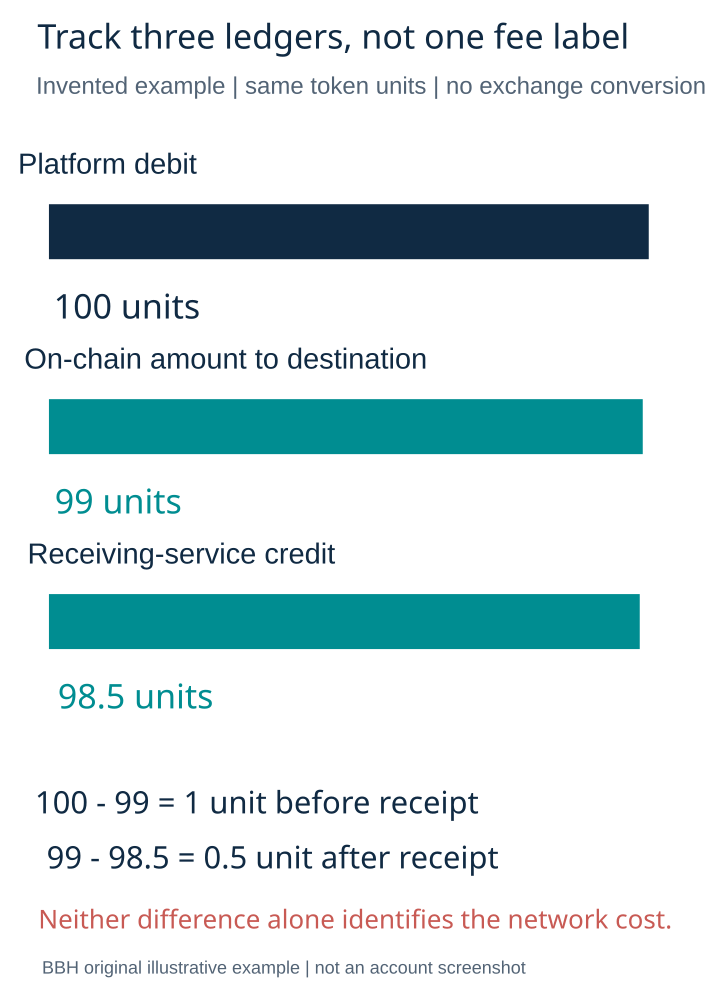
If the sender debits 100 units, the chain shows 99 sent to the correct destination and a receiving service credits 98.5, there are two differences to investigate: 1 unit before receipt and 0.5 after it. Do not assign both to the network fee without evidence. A native-asset fee paid by the sender can exist separately from either deduction.
Batched payments and tariff wording
One network transaction can contain several transfers. Its total fee should not automatically be treated as the cost of each customer’s withdrawal. Likewise, dividing a batch fee equally across recipients is only an allocation assumption unless the platform actually uses that rule. Ask how the disclosed withdrawal charge is determined.
As one provider-specific example, Deriv’s funds-and-transfers terms describe communicated virtual-asset fees and a possible adjustment reflecting network conditions. That wording is not a fixed fee quote, does not apply to every platform and does not establish what any individual transfer cost. Capture the tariff shown for the actual asset and network at approval time.
Compare these records with the payment research hub and use the calculation tools only with clearly labelled units and assumptions.
Crypto withdrawal fee FAQs
Does a zero platform fee mean no cost anywhere?
No. Check the transfer amount, conversion rate and receiving service’s terms. A zero charge in one ledger does not describe every stage of the route.
Can a failed Ethereum transaction still cost gas?
An included transaction that fails during execution can consume gas. Distinguish that from a request rejected before broadcast; inspect the actual receipt rather than relying on a generic failure label.
Should I add the network fee to the platform deduction?
Only if the records show it is an additional customer cost. Adding a network cost already covered by the platform’s stated charge would count the same expense twice.
Sources and research scope
Public-source review: 25 October 2026. Examples are illustrative. Documentary research does not represent funded-account testing. Rules must be checked against the current product, entity and customer location.
Related research
Payment cost research · Research methodology · Calculation tools
Risk: Fixed-outcome contracts can lose the entire stake. No chart pattern, calculator or demo result guarantees future returns.