


We may earn a commission through these partner links. Demo funds are virtual; access and country eligibility depend on the platform terms. Disclosure
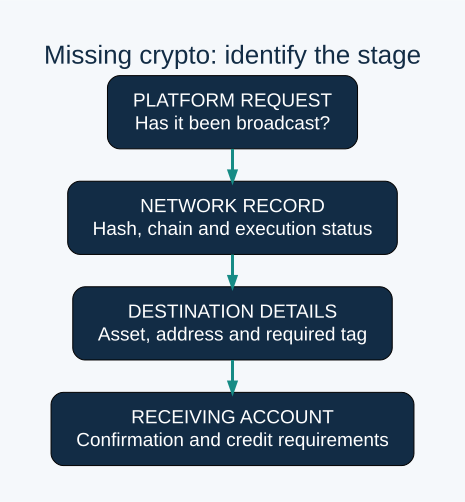
A missing crypto withdrawal can be waiting inside the sending platform, pending on a blockchain, or confirmed without the receiving service crediting your account. Start by identifying that stage. Sending a second payment does not explain what happened to the first.
This guide provides a network-aware troubleshooting checklist, an evidence table and support templates. Official network documentation and Coinbase’s own receiving guidance were checked on 24 October 2026. A service-specific instruction is an example, not a rule for every broker or exchange.
Record the exact asset, network and destination
Retain the withdrawal request ID, requested amount, amount sent after deductions, chosen network, destination address, submission time and any required memo or tag. Save the receiving service’s deposit instructions as well as the sender’s confirmation.
A token name such as USDT does not uniquely identify its network. Compare the exact network and, for tokens where applicable, the contract identifier supported by the receiver. A familiar address format is not sufficient evidence of compatibility.
| Field | Question it resolves |
|---|---|
| Internal withdrawal ID | Which platform request is being investigated? |
| Network and transaction hash | Which public transaction, if any, corresponds to it? |
| Asset and amount | What actually moved, rather than what was requested? |
| Destination and memo/tag | Was the payment addressed to the intended receiving account? |
| Receiving instructions | Was that asset/network combination supported? |
| Timestamps and status history | At which stage did progress stop? |
Crypto transfer evidence has three separate checkpoints
Conceptual teaching examples only: no personal documents, live transaction records or actual provider screens are shown.
A. Request → network → receiving account
Request ID + amount + selected network.
Transaction hash + chain + status + destination + relevant asset transfer.
Receiving account’s deposit record and credit status.
A request ID is not a transaction hash. An on-chain record is not automatically confirmation that a custodial account credited the correct user.
B. Example: chain success, credit unresolved
SUCCESSAccount credit
UNKNOWN
Reconcile the network, receiving address, token or asset identity, amount and any required memo/tag using genuine records. Check the recipient’s actual deposit requirements before deciding what is missing. A successful transaction status alone is not the whole receipt investigation.
No transaction is traced in this fictional example. Confirmation requirements vary; no universal count or delivery time is implied. Never share seed phrases or private keys with someone offering to trace or recover a transfer.
No transaction hash, or hash not found
An internal withdrawal reference is not necessarily a blockchain transaction hash. Ask the sender whether the payment was broadcast, on which network, and whether it can supply a genuine explorer link. A request marked completed should still be matched to evidence of the actual transfer.
If the hash cannot be found, first check spelling and network. A lookup on the wrong chain is not evidence that nothing was sent. If the sender reports a replaced transaction, request the replacement reference and its relationship to the original.
A public explorer is useful evidence, but a screenshot supplied by a stranger is not an independent lookup. Navigate through a trusted network or service resource. Looking up a public transaction should not require connecting your wallet, signing a message or revealing a recovery phrase.
Pending, failed and successful transactions are different outcomes
Ethereum’s transaction documentation explains broadcast, inclusion in a block and execution. Those network events differ from a platform’s internal approval. On Ethereum, transaction fees and execution also need to be considered; do not generalise Ethereum mechanics to every blockchain.
For a pending transaction, ask who controls the sending wallet and what options that sender supports. A customer withdrawing from a custodial platform generally should not assume they can change its transaction fee or nonce themselves.
For a failed execution, ask the platform to reconcile the request and account debit. A network fee can still be consumed even when an Ethereum transaction fails. Do not assume the entire requested withdrawal was delivered merely because a hash exists.
Correct address, wrong network: why matching characters is insufficient
Compare sender and receiver instructions side by side. Was the intended chain selected? Does the receiving service support that token on that chain? Was the destination copied from the correct asset page? These questions are more useful than checking only the first and last address characters.
Coinbase’s troubleshooting guidance explicitly asks customers to verify the receiving address and expected network, and to inspect block-explorer details. That supports checking compatibility; its own handling limits must not be treated as a promise from another exchange.
If a mismatch occurred, contact the receiving service through its genuine route. Ask whether it controls the destination on that network and whether its documented recovery process supports the case. Recovery may be impossible, unavailable or subject to conditions. Do not promise it based only on the address format.
Missing memo or destination tag
XRP Ledger documentation explains that a destination tag can identify which customer a shared receiving address should credit. A payment can therefore need more than an address for the receiving business to allocate it correctly. Depending on the address settings, a missing tag can cause rejection or require investigation.
Preserve the tag shown in the receiving instructions and the tag actually used. If different, ask the receiving service for its supported review process. Do not invent a tag or send a second payment as proof unless the genuine service’s documented procedure specifically calls for an action.
Confirmed on-chain but not credited to the receiving account
Check that the successful transaction actually includes the expected asset movement to the intended destination. On smart-contract networks, a token transfer may be shown in transfer details rather than the top-level native-coin value. A zero native value alone does not establish that no token moved.
Then check receiving requirements: confirmations, supported asset/network, account alerts and any minimum credited amount. Coinbase’s help page gives an example of account tasks affecting receipt, so blockchain confirmation alone does not prove its internal customer ledger is already updated.
Ask the receiver to investigate using the hash, network, asset, amount and destination. Do not apply one service’s confirmation count or follow-up time to another without checking its current instructions.
Reconcile withdrawal amount, fees and credit
Suppose a fictional request is for 100 tokens and a stated deduction is one token. The expected sent amount may be 99, depending on how the sender applies that charge. Compare that with the actual transfer and receiving credit before calling the difference missing.
A withdrawal fee is not automatically identical to the blockchain fee. A platform may batch transfers or charge under its own tariff. Request the applicable breakdown rather than assuming the explorer fee must equal the customer deduction.
Two concise support requests
To the sender: Please check withdrawal [ID], submitted [date/time/timezone] for [asset/amount] on [network]. Its status is [status]. Please confirm whether it was broadcast and provide the transaction hash, network, amount sent and any replacement reference. If not sent or failed, please reconcile the account debit.
To the receiver: Please investigate [hash] on [network] for [asset/amount] to [address and required tag]. The transaction shows [observed status], but my account has no matching credit. Please identify the missing receiving requirement or supported review process.
Keep full records privately and redact public copies. Never share seed phrases, private keys or authentication codes. A request to pay an unsolicited recovery agent does not establish control over the receiving address.
Frequently asked questions
Does a hash prove I received the withdrawal?
No. Match the network, execution result, asset movement and destination, then reconcile the receiving credit.
Can confirmed crypto always be reversed?
No. Do not assume a completed blockchain transfer has a bank-style reversal mechanism. Recovery options depend on the network and relevant party’s control.
Should I deposit more to unlock a missing transfer?
First verify the actual issue through genuine support. Another transfer does not trace the original one.
Sources and related guides
- Ethereum transaction documentation: network execution concepts.
- XRP Ledger destination tags: shared-address customer allocation.
- Coinbase send/receive troubleshooting: provider-specific examples.
Related: Payment troubleshooting hub · Pocket Option withdrawal · Quotex withdrawal · Research methodology.
Scope: Checked 24 October 2026. This is an educational investigation framework, not a guaranteed recovery process or independently tested provider performance.