


Deriv offers several trading interfaces and product types. A demo result should identify the exact platform and contract, rather than being presented as evidence about every Deriv service.
Start with the documented feature
Deriv describes virtual-funds practice in its app and separate MT5 demo material. The MT5 learning environment and an options interface do not become the same product simply because they use the same brand.
Read the current platform documentation and eligibility information. A virtual account’s availability does not establish that a corresponding live product is appropriate or available in every country.
Identify the product before the settings
A CFD simulation involves position size, price changes, possible leverage and closing mechanics. A fixed-outcome option involves its own condition, duration and payoff. Their result ledgers need different fields.
Do not compare a percentage shown for one product with a fixed profit payout for another without translating their underlying cash flows.
Use a platform-specific worksheet
| Field | Purpose |
|---|---|
| Platform | Identifies the actual interface |
| Account mode | Confirms virtual rather than funded money |
| Instrument | Includes the precise product specification |
| Exposure | Stake or position-sizing basis |
| Exit | Expiry, manual close or other rule |
| Net result | Uses the correct product accounting |
A fair comparison uses a shared question
If the question is ‘Can I find the contract specification?’, document that task on each interface. If the question is ‘How did this predefined rule perform?’, keep instrument, timing and payoff assumptions consistent where possible.
When the products differ materially, report the differences rather than forcing a ranked accuracy comparison. A lower virtual drawdown under different leverage or sizing is not automatically superior prediction.
Account resets and inactivity need documentation
Check the current help article for the relevant demo account’s conditions. Do not assume one platform’s retention or virtual-fund reset rule applies to every other interface.
Keep your own export or journal before resetting or replacing an account. A new virtual balance should start a new experiment record, not erase the earlier result.
Finish with the limits of the evidence
Virtual practice can establish familiarity with controls and generate a clearly labelled sample. It cannot establish live fills, payment performance or a stable future edge.
Keep the account’s legal entity and local permissions in a separate research checklist. A successful demo login answers a technical-access question, not a regulatory one.
Opening an MT5 demo: what the official guide says
Deriv’s MT5 demo page describes signing up or logging in, adding a selected MT5 demo account in the dashboard and setting an MT5 password. Treat this as an MT5-specific setup outline. An options account, dashboard login and MT5 trading login should not be treated as interchangeable credentials or accounts.
After setup, confirm the account mode, account type and instrument specification before a practice order. If a connection fails, compare the account details with those shown in the genuine dashboard rather than repeatedly trying unrelated server choices. Use official support for an unresolved mismatch and never disclose passwords to a private troubleshooting agent.
Demo expiry: an important documentation difference
At the 24 October 2026 source review, the MT5 product page says the demo does not expire. However, the dedicated help article says it stays active with use and is automatically deactivated after 30 days of inactivity; a new account can be created through the Deriv account.
These statements should not be collapsed into an unconditional promise of permanent retention. Check the current help information and applicable terms for the exact account you use. Save your own journal before a long break. This article reports the wording difference rather than claiming to have independently tested the inactivity policy.
Separate CFD and option practice records
| Learning question | CFD practice record | Fixed-outcome option record |
|---|---|---|
| What creates exposure? | Volume, contract specification and price sensitivity | Stake or contract purchase cost and payoff condition |
| When does it finish? | Closing order or applicable position rule | Defined expiry or other specified contract rule |
| What affects the result? | Price movement and applicable dealing/holding costs | Whether the condition is met and the accepted payoff |
| What should be compared? | Net result relative to stated exposure | Net result relative to stake across complete outcomes |
The option column concerns fixed-outcome contracts; it is not a description of every option structure offered under the brand. Read the particular contract rather than importing an assumption from a different interface.
Two worked examples without invented platform specifications
Illustrative CFD exercise: assume a fictional instrument where the chosen position gains or loses 2 account units for each one-point price movement. A five-point favourable movement represents 10 units before costs; a five-point adverse movement represents minus 10. This is a teaching assumption, not a Deriv contract specification. Find the actual symbol’s volume and contract details before calculating its sensitivity.
Illustrative fixed-outcome exercise: assume a 10-unit stake with an 8-unit net winning profit and a full 10-unit losing stake. Five wins and five losses yield 40 minus 50, or minus 10 units. Calling this sample “50% accurate” leaves out the payoff imbalance. Neither example can be ranked against the other without explaining exposure, costs and decision rules.
Design a comparison that answers one question
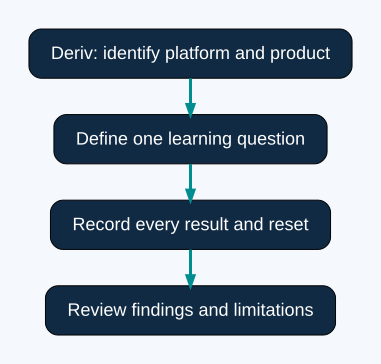
Use one written rule version and a defined observation period. Record all outcomes, including skipped setups, rejected orders and input mistakes. Keep development observations separate from a later evaluation sample. If you change the instrument, account type or exit rule, label the change and begin a new comparison segment.
When comparing platforms, first ask whether the underlying contract and price source are actually comparable. A derived index and an exchange-traded instrument are not interchangeable observations merely because their charts look similar. Different sessions, sizing and exit mechanics can explain different virtual results without demonstrating better forecasting.
Frequently asked questions
Can virtual profits be withdrawn?
No. Virtual practice funds are not withdrawable cash. A real account’s funding and withdrawal processes need separate investigation; see our deposit and withdrawal research.
Is one starting balance guaranteed across all demo products?
This guide does not make that promise. Read the current account screen and product documentation. A balance advertised for one platform or jurisdiction should not be presented as universal.
Does a demo reset preserve my performance evidence?
Do not assume it does. Save the relevant records first and record the adjustment separately from trading profit or loss. A restored balance cannot erase an earlier drawdown from an honest experiment.
Does accessing a demo establish local permission?
No. Access, product eligibility and the contracting entity’s permissions are separate questions. Our country research explains the evidence needed for jurisdiction checks.
Sources and research scope
Public-source review: 24 October 2026. Examples are illustrative. Documentary research does not represent funded-account testing. Rules must be checked against the current product, entity and customer location.
Related research
Deriv research · Research methodology · Calculation tools
Risk: Fixed-outcome contracts can lose the entire stake. No chart pattern, calculator or demo result guarantees future returns.