


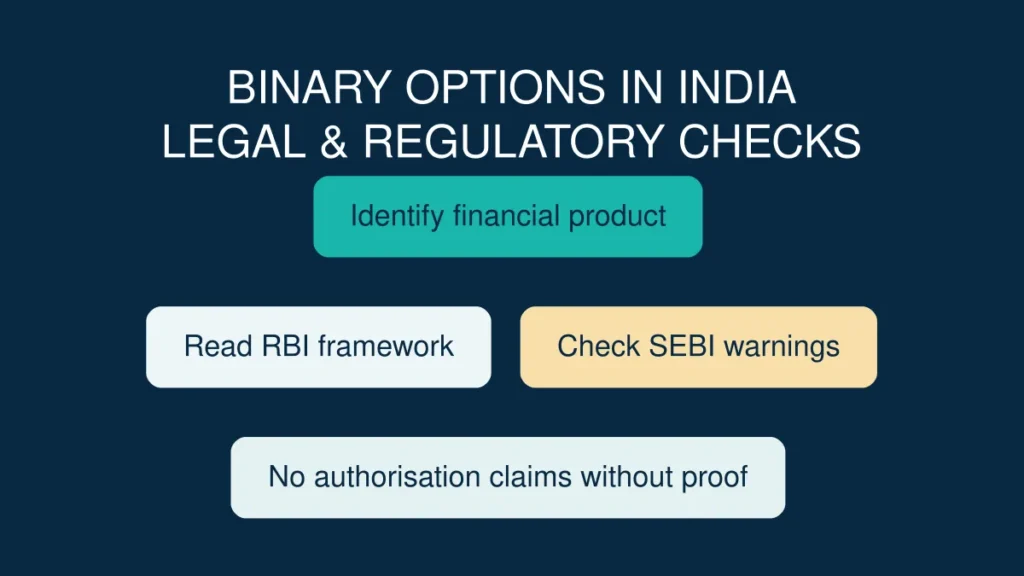
Is binary options trading legal in India? The answer depends on the exact financial product, operator and activity—not just whether a website accepts an Indian mobile number. This guide explains what RBI and SEBI documents can establish, what their warning lists cannot prove, and how to research broker claims without risking money unnecessarily.
Editorial scope: general educational review of publicly available regulatory information, October 2026. This is not legal advice, a company authorisation certificate or a broker recommendation. Always consult current official notices for an individual case.
The first question is the contract, not the app name
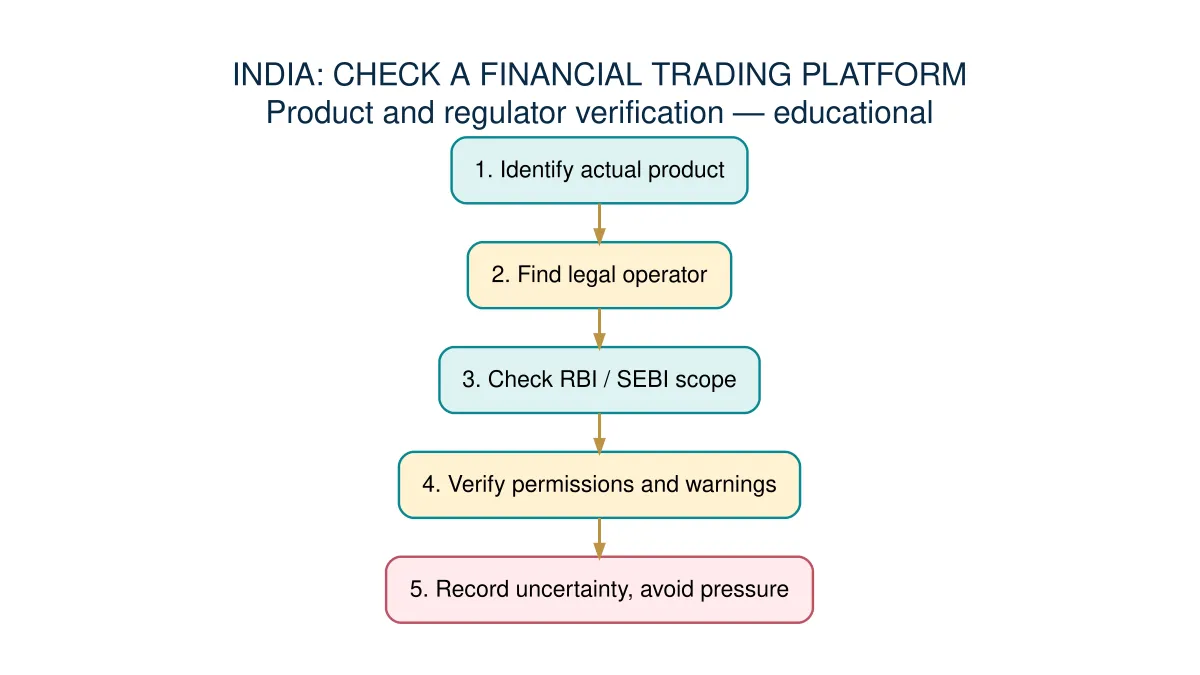
A search for “binary options trading in India” is often framed as a simple yes-or-no question: is the app legal? A careful answer starts by identifying what the app actually offers. A fixed-outcome binary contract, a currency derivative, spot currency exchange and a regulated exchange-traded option are not necessarily the same product. Their contractual rights, settlement methods and regulatory treatment can differ. Do not assume that a platform is selling shares just because its screen displays a stock chart, or that it provides a permitted forex instrument because its chart shows EUR/USD. Before checking a licence, write down the exact instrument, how a position is created, what happens at expiry and which legal company is named in the contract.
Website access does not prove India-specific authorisation
A website can technically load in India, display prices and accept a local mobile number without having regulatory permission to offer the particular activity. App-store availability, a website’s language setting and a customer-support phone number also do not establish the legal status of a financial contract. They are interface or marketing details. If a referral page claims that a platform is “approved in India,” ask for the exact company name, the authorising regulator, the register entry, permitted products and current date. A generic certificate image or logo cannot answer all these questions. Where evidence is missing, the honest conclusion is “not verified,” not “safe” or “approved.”
What the RBI regulates in this context
The Reserve Bank of India explains the framework for foreign-exchange transactions by resident persons, including the use of authorised persons and permitted purposes under the Foreign Exchange Management Act (FEMA). RBI also has rules about electronic trading platforms, or ETPs, for eligible financial instruments. An operator whose actual product and activity fall into this regulatory scope must be assessed against those specific requirements. Not every online chart or contract can be classified merely from its branding, and one should not apply the same RBI rule automatically to every asset and derivative. For a particular offer, identify the company, customer location, instrument and payments arrangement, then consult the applicable official documentation or qualified legal guidance.
The RBI Alert List: what it means and what it does not
RBI publishes an Alert List of certain entities that are not authorised to deal in forex under FEMA or operate ETPs for forex transactions under the applicable directions, as well as some entities promoting such unauthorised services. RBI expressly says the list is not exhaustive. Therefore, an entity that does not appear on it should not be assumed to be authorised. This is an important distinction because partner landing pages sometimes use absence from a warning list as supposed evidence of safety. A historical version of the list may also have changed, so readers should look for the most recent publication on RBI’s official website and check the appropriate authorised-person or authorised-ETP lists rather than relying on a screenshot copied from a blog.
Authorised persons and electronic trading platforms are distinct
A company can have a brand name that sounds financial without holding permission to act as an authorised person for forex dealings. Similarly, software that provides access to prices is not automatically an RBI-authorised ETP. RBI’s official FAQ distinguishes authorised persons, recognised exchanges and ETP permissions under its framework. It also notes the importance of permitted transaction purposes and applicable remittance restrictions. Readers should not infer authorisation from terms such as “international,” “digital,” “registered company” or “regulated partner.” Company incorporation, financial authorisation and product approval are separate questions. Checking the appropriate official list is more reliable than taking claims from advertisements at face value.
Where SEBI investor protection information helps
The Securities and Exchange Board of India publishes investor education about fraudulent investment apps, impersonation and scam practices. SEBI materials describe situations in which social-media contacts promise high returns, send people to fake platforms, show growing balances and later block withdrawals or demand additional fees. These resources are valuable for recognizing fraud patterns, but a general investor-awareness warning is not a licence determination about every named binary platform. The right approach is to use SEBI’s official investor pages for due-diligence guidance and check the exact product and regulated intermediary, if any. Do not mix up a registered Indian stockbroker’s authorised mobile trading app with an unrelated global binary-outcome product.
The 2026 verified app label has a specific scope
In March 2026, SEBI announced a verified-label initiative for stock-trading apps of brokers registered with SEBI on Google Play. The initiative was introduced to help investors distinguish genuine registered-broker apps from impersonators. This is a useful development for that defined category of securities-market applications, but it must not be presented as approval of every finance-related app on Android. A different binary-style trading website does not become SEBI-registered because a visually similar badge appears in its promotion. If a page claims that a company is an Indian registered broker, check the actual intermediary and product against SEBI and relevant market-infrastructure records.
A practical seven-step due-diligence process
Start with the product: what contract is being offered and how could you lose money? Next, find the contracting entity in the latest terms and note the company address and jurisdiction rather than the marketing brand alone. Third, look up any licence number and the exact regulator, matching names character for character. Fourth, verify the specific activity permitted by that record; a permission for one service does not cover every derivative. Fifth, check RBI or SEBI warnings where they are relevant, remembering that warning lists have defined scopes. Sixth, read terms for client money, KYC, withdrawal restrictions and complaint procedures. Finally, record the URL and date of each source. If key questions remain unanswered, do not replace evidence with guesses.
Do not confuse an app download with holding an asset
A binary outcome based on whether the price of a currency pair rises at expiry generally differs from owning currency or holding an exchange-traded security. Investor.gov describes a binary option as a yes-or-no contract in which the payoff depends on a condition, and the holder does not thereby acquire ownership of the underlying asset. Similarly, a screen displaying a crypto symbol does not automatically mean that Bitcoin has been bought and placed into a wallet. For an India-focused page, the product distinction matters because payments, authorisation and consumer protections depend on what is actually being sold. A chart is a visual tool, not a complete legal contract.
Why payout maths belongs in a legality guide
Even if a financial product’s legal status has been carefully researched, it can still expose someone to severe losses. Consider a hypothetical fixed-outcome contract risking 100 units with 80 units of profit when successful and a full 100-unit loss when unsuccessful. Five wins generate 400 units of profit and five losses cost 500, yielding minus 100 before additional costs. The simple break-even success threshold is 100 divided by 180, approximately 55.56%. A quoted 80% payout is not an 80% chance of winning. When comparing products, explain the downside and distinguish a mathematical example from any provider’s live quotation. Never present a high payout percentage as a safety rating or a reliable income figure.
Deposits, withdrawals and identity documents
Before handing over funds, check the current customer agreement for account verification, deposit methods, withdrawal processing, fees, limitations and the complaints route. A promotional claim that withdrawals are “instant” does not independently verify a successful withdrawal, and anecdotal screenshots do not prove the experience is typical. A fraudster may ask for additional payments to “release” money or direct funds to a personal bank account. SEBI’s fake-app warnings describe comparable pressure tactics. Protect passwords, one-time codes, payment credentials and identity documents. If you cannot confidently establish who holds the money and which rules govern withdrawal, that uncertainty should weigh heavily in any decision.
Country comparisons require different regulatory conclusions
Advice that applies to an Indian resident may not automatically apply to a UK resident or someone elsewhere. The UK’s Financial Conduct Authority has prohibited firms acting in or from the UK from marketing, selling or distributing binary options to retail consumers. India requires analysis of its own legal framework and the specific contract offered. The mere fact that one country imposes a clear product prohibition does not allow a blog to announce an identical rule for every other country without a primary legal source. Likewise, an overseas operator’s claim of holding an international certificate does not automatically establish permission to market a specific retail contract to residents of India.
Why generic ‘legal or scam?’ rankings can mislead
A broker-comparison page may blend several separate questions into a single star score: whether software works, whether customer service responds, whether money is withdrawable, whether the activity is legally authorised, and whether the contract makes economic sense. A high rating in one area does not resolve the others. A site that earns referral commissions has a financial incentive to encourage registrations, so readers deserve clear disclosure and evidence-led conclusions. Before trusting a “top broker for India” article, check who wrote it, which official sources support the claims, when they were checked and whether country restrictions are clearly explained. Avoid fixed rankings based on unsupported payouts or licence descriptions.
A note about RBI materials and their dates
Regulatory information can change. A particular copy of RBI’s Alert List or FAQ may show a date from an earlier year; a blog should not describe it as the latest version unless that has been confirmed on RBI’s current official website. The existence of a recent unrelated forex policy announcement does not automatically change the legal treatment of every binary contract. Distinguish a formal rule, a general warning, a list of named entities and commentary about market conditions. If a specific rule is difficult to interpret, quote its relevant scope accurately and encourage readers to consult the regulator or qualified adviser rather than pretending that one sentence settles a complicated legal question.
What to do if you suspect a fake trading app
If an unfamiliar contact urges you to deposit quickly or asks for an OTP, stop and preserve any messages or transaction records without sharing them more widely. For suspected financial cyberfraud in India, official investor-awareness guidance points readers toward cybercrime reporting channels and appropriate authorities. Be cautious about follow-up “recovery agents” who promise to retrieve losses in exchange for another payment: a second scam can target people who already lost money. Avoid trying to recover a previous loss through larger positions, borrowed money or a new unverified platform. Personal financial protection is more important than any countdown timer on a trading website.
A realistic beginner research worksheet
Create a table with columns for Claim, Source URL, Regulator or Company, Date Checked and Status. Examples of claims might include “operator is authorised,” “binary product is available to Indian residents,” “withdrawal terms allow a specified process” and “a quoted payout applies to this instrument.” Mark each as verified, contradicted, or unverified. For claims of authorisation, only rely on the relevant official records and their permitted activities. For features, use the provider’s dated documentation while clearly identifying it as a company claim. For personal returns, no marketing screenshot can guarantee future outcomes. This exercise is more useful than searching for a single yes-or-no headline.
Bottom line for India readers
Do not let a globally accessible trading screen answer a legal question it cannot answer. Identify the exact financial product and operator, understand the possible full-stake loss, consult the relevant RBI or SEBI official materials and verify any claimed permission in the correct register. Treat RBI’s Alert List as a warning resource with a limited, non-exhaustive scope, not as a universal approval database. This article is general education, not personalised legal or financial advice and not an endorsement of any binary-options service. If the product, operator or permissions remain unclear, choosing not to deposit is a reasonable outcome of your research.
India-specific verification checklist
| Question | What to consult | What not to conclude |
|---|---|---|
| What product is offered? | Current contract and settlement terms | Asset ownership from a chart label |
| Who is the contracting company? | Legal entity named in the agreement | Brand name equals the authorised entity |
| Is the activity forex/ETP-related? | Relevant RBI framework and registers | One warning list covers every product |
| Is it a securities-market app? | SEBI and exchange intermediary records | Any app listing implies broker registration |
| Can customer money be lost? | Stake, expiry and payout conditions | 80% payout equals 80% win probability |
| Are claims independently verified? | Official sources with dates | Social media reviews equal legal proof |
Frequently asked questions
Does a website opening in India mean it is RBI or SEBI approved?
No. Accessibility and financial authorisation are different. Identify the company, product and activity and consult appropriate official sources.
If a company is not on RBI’s Alert List, is it authorised?
No. RBI expressly states that the Alert List is not exhaustive and absence does not establish authorisation.
Does a Google Play Store listing mean a trading app is SEBI registered?
No. SEBI’s verified app label is designed for a defined set of registered stockbrokers; a generic app listing does not prove financial permission.
Is every binary-style contract treated exactly like Indian exchange-traded options?
No. Legal classification and consumer rights depend on the actual financial contract and activity.
Can a payout calculator tell me whether trading is legal?
No. It calculates hypothetical profits and losses, not licensing or the legal treatment of a product.
Should I use borrowed money to make up a previous loss?
Borrowing adds a repayment obligation and can magnify speculative losses; it is not a reliable recovery method.
Official sources and related guides
- RBI FAQ — Forex transactions and electronic trading platforms: framework, ETP scope, warning-list limitations and authorised sources.
- RBI — Alert List (archived publication; verify latest version): a dated record showing the non-exhaustive character of the list.
- SEBI — March 2026 verified trading-app label announcement: registered stockbroker app scope.
- SEBI Investor — Fake trading-app scam warning: common fraud indicators.
- Investor.gov — Binary options contracts and fraud: fixed-outcome risk background.
- BBH Country Rules, Academy and Blog archive.
Commercial policy: This legal-risk guide does not recommend a platform or provide broker sign-up links. Any partner arrangement elsewhere on the site requires clear disclosure and must not override country restrictions or factual research.