


We may earn a commission through these partner links. Demo funds are virtual; access and country eligibility depend on the platform terms. Disclosure
A signal provider’s claimed accuracy needs a complete timestamped record and a defined evaluation rule. A collection of winning messages cannot establish the result a subscriber could actually obtain.
Define what counts as one signal
Record the instrument, direction, entry convention, expiry, publication time and allowed execution window. Clarify whether a sequence of recovery entries counts as several contracts or is being reported as one eventual win.
If the provider changes a message after publication, preserve both versions. Deleting a losing call or moving its expiry changes the record being evaluated.
Ask for an unselected history
A useful sample includes every signal in a stated period, losses, cancellations and missed entries. Public screenshots can omit inconvenient days or show calls that subscribers could not execute at the displayed price.
Investor.gov warns that social-media investment recommendations and impersonation can be used in fraud. That warning supports verification; it is not proof that every signal service is fraudulent.
An evidence checklist
| Claim | Evidence needed |
|---|---|
| High accuracy | Wins, losses, denominator and inclusion rule |
| Subscriber results match | Actual entry times, prices and payouts |
| Profitable | Net ledger including stakes and fees |
| Independent testing | Named method and reproducible records |
| Authorised advice | Relevant current permission where required |
Accuracy is not net return
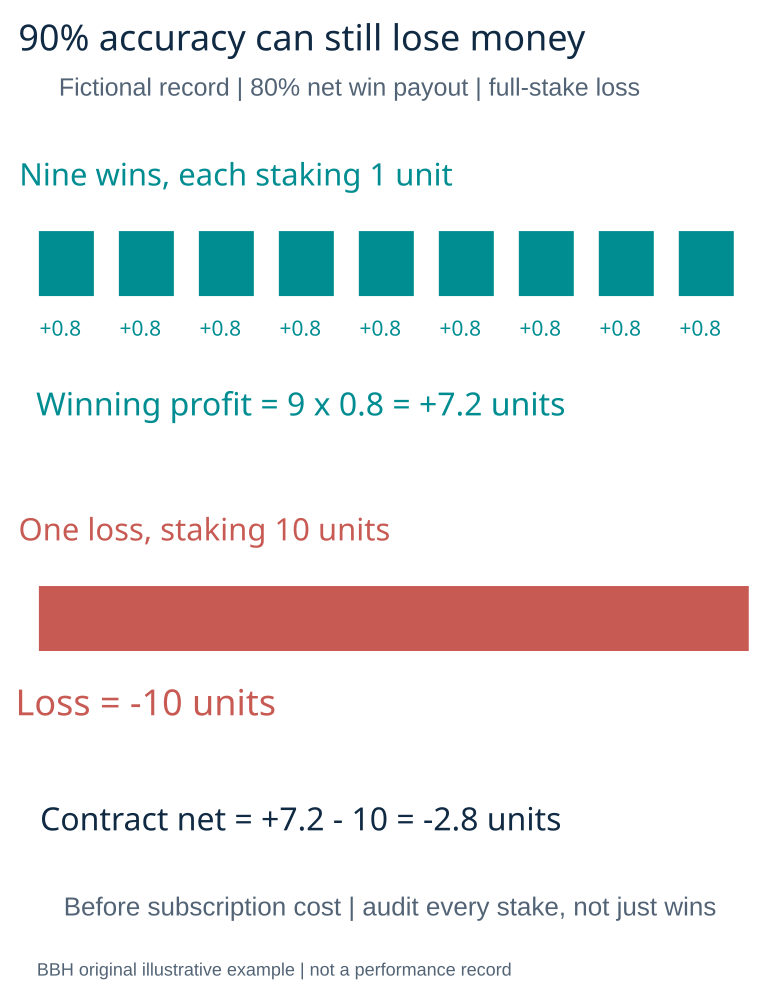
Imagine nine one-unit wins at 80% and one ten-unit loss. The hit rate is 90%, while the net contract result is −2.8 units before the subscription cost.
A service charging five additional units for that period would reduce the total further. These invented numbers show why both stake history and subscription fees matter.
Do not grant access just to verify a claim
A provider does not need your password, authentication codes or remote control to supply a historical signal log. Browser extensions and bots create separate security questions.
Review the genuine platform’s rules before enabling automation. A promised advantage is not evidence that an integration is supported or permitted.
Use a limited observation study
If assessing public claims, record signals as received and evaluate them using a fixed demo methodology. Keep incomplete and unexecutable entries visible.
A positive sample does not guarantee a future edge. Avoid services promising certain recovery or income, and distinguish documentary review from a funded test that has not been performed.
Freeze the observation rules before seeing results
A signal audit needs a rulebook written before the sample begins. Specify the venue and exact instrument, whether the quote is OTC or exchange-linked, the intended entry time, expiry convention, payout and treatment of ties. A direction without an executable entry and settlement rule is incomplete evidence. Do not repair those omissions after seeing which choice would have won.
| Audit field | Record at receipt |
|---|---|
| Original message | Unique reference, publication time and unedited instructions |
| Delivery | Subscriber receipt time and any delivery gap |
| Execution | Eligible window, available quote and actual demo entry |
| Economics | Stake, quoted payout, result and costs |
| Exceptions | Late, missing, cancelled, edited or unexecutable calls |
Publication, receipt and execution are different timestamps. A message posted before a candle closes can reach a subscriber after the entry window ends. Keep it in the delivery record rather than counting a hypothetical earlier entry as the subscriber’s result. Results on a different venue or OTC price series may not reproduce the advertised outcome.
Worked example: equal stakes still need the payout
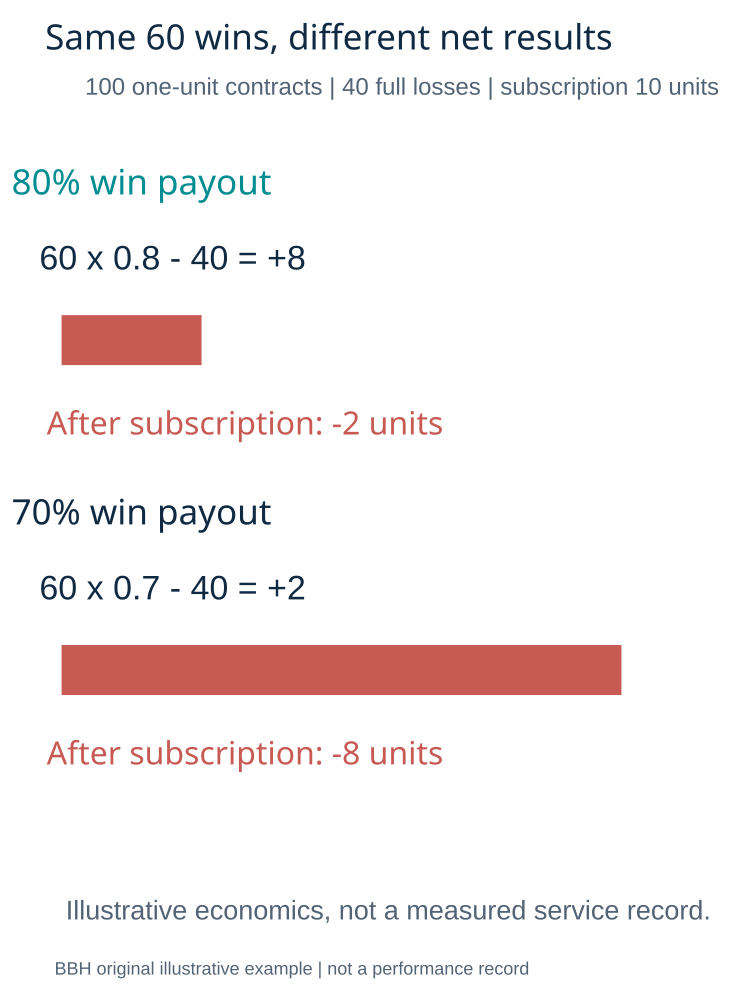
Suppose an illustrative record has 100 executable contracts, each risking one unit, with 60 wins and 40 losses. At an 80% net profit payout per win, the gross contract result is (60 × 0.8) − 40 = 8 units. A 10-unit subscription cost makes the combined result −2 units before other costs. The 60% hit rate has not changed.
At a 70% payout, the same win/loss record produces (60 × 0.7) − 40 = 2 units before subscription, or −8 after that 10-unit cost. With fixed payout r and full-stake losses, the break-even win rate before costs is 1 ÷ (1 + r): about 55.56% at 80% and 58.82% at 70%. Varying payouts require a contract-by-contract ledger.
Count recovery entries as actual contracts
A sequence that loses a one-unit stake and then wins a two-unit stake at 80% produces −1 + 1.6 = 0.6 units. It contains two contracts, including a loss. Reporting only an eventual winning sequence hides the exposure and the contract denominator. A sequence that fails at every step can have a much larger loss than a normal single entry.
Record both sequence-level and contract-level outcomes if recovery trading is part of the advertised method. Include the maximum committed stake, concurrent positions and full failed sequences. A high sequence success rate alone cannot establish profitability or acceptable drawdown.
Missing calls are part of the evidence problem
If a channel issued 120 messages but only 100 were executable under the frozen rules, report both counts and the reasons for the other 20. Calculate the observed win rate among eligible executed contracts and show the excluded group separately. Neither silently deleting those messages nor assigning invented results to them creates a reliable full history.
Read the signals and automation research alongside the calculation tools. A forward demo log can examine delivery and consistency, but it does not establish funded execution quality or guarantee future performance.
Trading signal accuracy FAQs
Does an audited winning month prove a lasting edge?
No. Sample size, market conditions, selection and execution differences remain relevant. Keep the period and limitations visible.
Does an “AI” label verify the performance claim?
No. Ask for the same original records, rule definitions, economic results and disclosure of edits that you would require from any other service.
What should I check before paying?
Verify who operates the service, its terms, cancellation process, conflicts and any permissions required for its actual activity and your location. Regulatory registration is a separate question from whether its advertised accuracy is reproducible.
Sources and research scope
Public-source review: 25 October 2026. Examples are illustrative. Documentary research does not represent funded-account testing. Rules must be checked against the current product, entity and customer location.
Related research
Signals and automation research · Research methodology · Calculation tools
Risk: Fixed-outcome contracts can lose the entire stake. No chart pattern, calculator or demo result guarantees future returns.