


We may earn a commission through these partner links. Demo funds are virtual; access and country eligibility depend on the platform terms. Disclosure
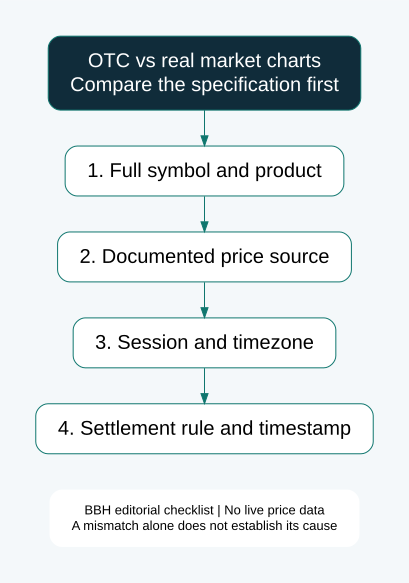
OTC and ordinary-market charts should not be assumed to represent the same instrument or quote stream. A familiar currency-pair name is only the start of the comparison. Check the full symbol, documented price reference, session and contract settlement rule before treating one chart as proof of what the other should show.
Research updated 23 October 2026. Public-source analysis with illustrative numerical examples; no proprietary price feed audited and no live trading test performed.
What does OTC mean on a binary-options platform?
OTC stands for over-the-counter. The term alone does not describe a universal price-generation method. In this article, “OTC” refers specifically to broker-labelled fixed-outcome instruments carrying that designation, while “ordinary market” means the comparison symbol without that suffix. “Real market” is a common search phrase, not a technical guarantee that a screen is an exchange’s official settlement source.
Pocket Option’s OTC asset schedule separately labels instruments and says OTC availability can include weekends and periods when the usual asset is unavailable. It specifies server time as UTC+2 on the page checked. This establishes the published schedule description, not the hidden mechanics behind every tick.
Do not turn “OTC” into an unsupported statement that all providers use identical random algorithms. Conversely, do not assume an OTC-labelled chart must mirror an exchange simply because the name contains a familiar stock, currency or crypto asset. Ask for the exact product specification.
OTC vs real-market binary options: what actually needs comparing?
| Dimension | OTC-labelled symbol | Ordinary comparison symbol |
|---|---|---|
| Identity | Record the full name including OTC suffix. | Record the full name and data provider or venue. |
| Pricing | Find the disclosed reference and construction rules. | Find the feed and whether it shows bid, ask, midpoint or trades. |
| Availability | Read the exact provider schedule. | Check the instrument’s actual trading session. |
| Settlement | Identify the contractual closing source and timestamp. | Do not assume an outside chart governs another contract. |
| Data history | Check what timestamped history can be obtained. | Check historical coverage and any data adjustments. |
| Payoff | Record the quoted payout and tie treatment. | Identify the product before comparing returns. |
This is a research framework, not a table of universal broker features. An ordinary symbol can still represent a derivative rather than ownership of the underlying asset. A chart without an OTC label is not automatically a safer contract or a single authoritative world price.
What Pocket Option and Quotex documents establish—and what they do not
Pocket Option’s Public Offer describes a terminal quote calculated from bid and ask, server-side execution and comparison of contract opening and closing values. These are its published terms; we have not audited their implementation.
Quotex’s Trading Operations Rules, 4.12–4.15, identify its server as the quote reference, allow source selection and distinguish displayed charts from execution information. A difference from another source is not by itself grounds for revision under that wording. This is a statement of the provider’s contractual position, not an independent finding that a particular disputed result was correct.
Neither a schedule nor a general contract description supplies enough information to reconstruct every proprietary OTC series. Where the exact reference, historical ticks or construction method are unavailable, the honest conclusion is that those details remain unresolved.
Why can an OTC chart move on a weekend?
A weekend-labelled product can have its own availability schedule. A screen continuing to move does not establish that the named underlying exchange is open. Nor does the opposite assumption work: not every market closes on the same calendar.
For a fair check, write down the date, exact symbol, provider, session timezone and source schedule. Convert the timestamps before comparing a Saturday screenshot with another platform. A local calendar date can differ from the server date around midnight.
Illustrative conversion: when a schedule uses UTC+2 and your comparison uses UTC+5:30, the difference is three hours and 30 minutes. A displayed 09:00 server time corresponds to 12:30 in the latter zone under those stated offsets. Verify the actual offset for the date rather than assuming every system uses the same daylight-saving rules.
Weekend access is a scheduling characteristic. It does not establish favourable odds, stronger protection or predictable price behaviour. Do not use availability as a substitute for understanding the contract.
EUR/USD OTC vs EUR/USD: the name is not the specification
Suppose screen A says “EUR/USD OTC” and screen B says “EUR/USD” with a separate provider identifier. They share a currency-pair label but have not yet been shown to share a quote source. Comparing candle colours before checking that fact skips the most important step.
Record both complete labels. Then ask what price each chart represents, whether the observation belongs to an overlapping session and how bars are assembled. A recognisable pattern on one series is not evidence that the next bar on another series must follow it.
This also applies to crypto names. A fixed-outcome contract referencing a crypto label is different from owning coins on a spot exchange. Establish the product and settlement reference before importing a spot-market conclusion into an OTC contract.
A tiny quote difference can change a fixed-outcome result
Consider an illustrative upward contract opened at 1.08000. At its expiry, feed A shows 1.08002 and feed B shows 1.07999. Under a simple strictly-above rule, A is above the opening level while B is below. The visible difference between the closing values is only 0.00003, but the classification changes.
The arithmetic does not establish that either feed is wrong. The research question is which reference the contract specifies and what the accepted entry, expiry and settlement records actually contain. Also check how an exact tie is treated rather than silently applying a rule from another platform.
A one-minute candle’s close is not automatically a contract’s expiry price. A contract could begin during that minute and expire later. Keep candle interval, contract duration and exact settlement timestamp as three separate fields.
How to compare OTC and ordinary charts without inventing a backtest
- Define the question before observing. For example: do two identified series share the same one-minute closes during a specified window?
- Record product identity. Preserve full names, suffixes, provider labels and contract type.
- Align timestamps. Record date, offset, seconds where available and the exact bar start/end.
- Identify the price field. Do not mix bid, ask, midpoint, last trade and settlement without labelling them.
- Keep raw observations. Save both values and the evidence rather than only marking a match or mismatch.
- Label missing information. An undocumented source is an unresolved field, not permission to invent its origin.
- Separate datasets. Keep OTC and ordinary-session observations distinct until comparability is established.
- Report limits. State the window, sample selection and what was not independently verified.
Use observation or demo records instead of depositing money solely to investigate a pricing question. A demo exercise can test whether your recording method works; it cannot establish live execution quality or withdrawal performance.
Can candlestick patterns, RSI or TradingView signals transfer to OTC?
An indicator calculation uses the input series supplied to it. To compare results, match both the formula and the underlying observations. A different sequence can produce a different output even when the indicator settings look identical.
For example, calculate a three-close average from hypothetical values 100, 102 and 101: the average is 101. Change the last input to 98 and the average becomes 100. The same rule has changed because its input changed. This explains a data dependency, not a profitable signal.
Before interpreting candles, learn the basic fields in our OHLC guide. For one-minute observations, the one-minute candle guide explains why a moving bar should not be mistaken for a completed one.
Does a chart mismatch prove manipulation?
No single mismatch establishes its cause. Product identity, feed, price field, timestamp and capture quality must first be checked. Equally, “different feeds” should not be used to dismiss every documented complaint without examining it.
Preserve the contract ID, accepted entry, expiry, result and applicable rules. Add the outside chart as contextual evidence with its full source. Ask the provider which record determined the outcome. A support reply that merely repeats a label does not answer a specific question about a timestamped record.
OTC vs real-market charts: FAQs
Are OTC charts fake?
“Fake” is too imprecise without evidence. Identify what the provider says the instrument represents, then check the claim. A separate product is not proven fraudulent simply because it differs from an unrelated chart.
Is OTC easier to predict?
This research establishes no comparative prediction advantage. A few successful examples cannot support a general win-rate claim.
Can I find the exact OTC chart on TradingView?
Only claim a match when the exact instrument and feed are documented. A similar asset name or a community script is insufficient evidence of equivalence.
Is ordinary-market trading risk-free?
No. Correctly identifying a price source does not remove trading risk, counterparty risk or country-specific restrictions.
Sources and further research
Sources checked 23 October 2026: Pocket Option OTC schedule, Public Offer and Quotex Trading Operations Rules. Original examples use hypothetical values, not collected broker ticks.
Continue with the OTC research hub, Pocket Option review, Quotex review and research methodology.
Risk: Fixed-outcome contracts can lose the full stake. No chart, indicator or data comparison guarantees a profitable outcome.