


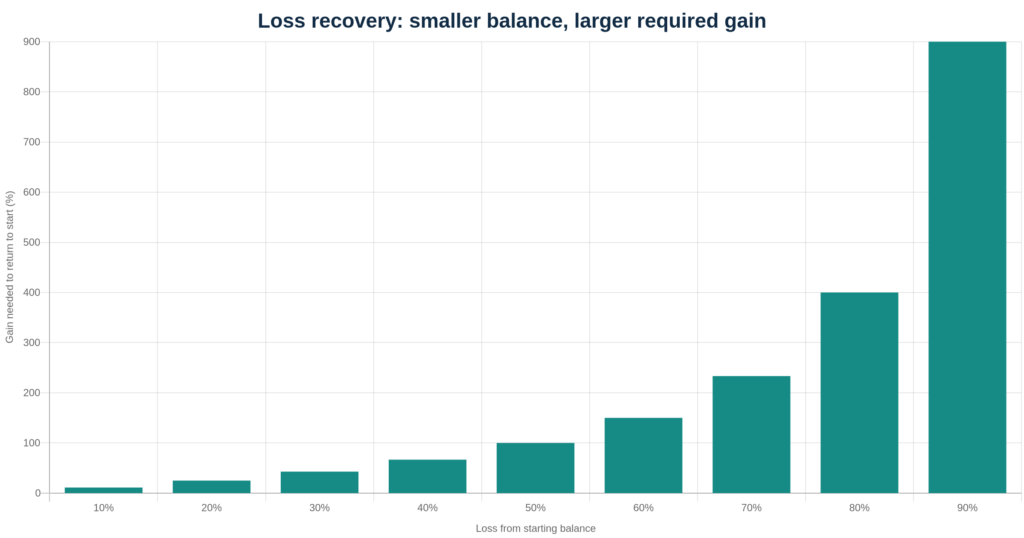
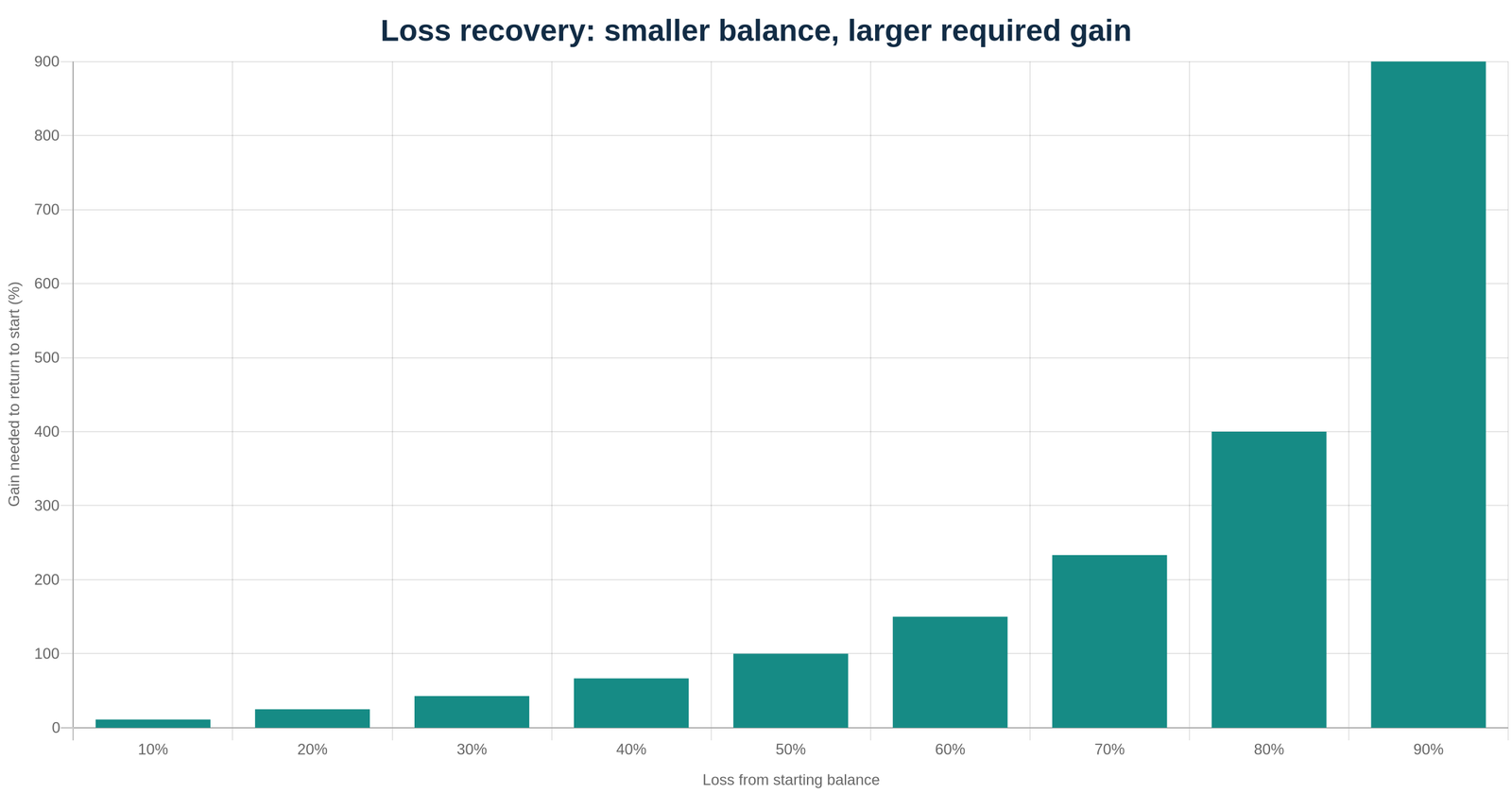
A 50% loss needs a 100% gain to return to the starting value. The reason is the smaller balance: losing 500 from 1,000 leaves 500, so earning back the missing 500 means doubling what remains. Loss recovery maths describes that gap; it does not predict that you can close it.
This guide covers the percentage loss recovery formula, a drawdown recovery table, repeated-loss examples and the difference between trading profit and adding new money. All amounts are illustrative, in one consistent currency, with no borrowing or leverage unless explicitly mentioned.
How to calculate the gain needed after a loss
Let B be your starting balance and d the loss as a decimal. After the loss, the remaining balance is B × (1 − d). The missing amount is B × d. Divide the missing amount by the remaining balance to calculate the required gain: d ÷ (1 − d).
If you enter the loss as a percentage L, required recovery (%) = L ÷ (100 − L) × 100. With a 25% loss, the calculation is 25 ÷ 75 × 100 = 33.33%. With a 50% loss, it becomes 50 ÷ 50 × 100 = 100%.
An alternative formula is (starting value ÷ remaining value − 1) × 100. For a balance that fell from 2,000 to 1,400, this gives (2,000 ÷ 1,400 − 1) × 100 = 42.86%. Check that your two values use the same currency and exclude transfers before interpreting the answer as performance.
Loss recovery percentage table
| Loss | Remaining | Amount missing | Required gain |
|---|---|---|---|
| 10% | 900 | 100 | 11.11% |
| 20% | 800 | 200 | 25% |
| 30% | 700 | 300 | 42.86% |
| 40% | 600 | 400 | 66.67% |
| 50% | 500 | 500 | 100% |
| 60% | 400 | 600 | 150% |
| 70% | 300 | 700 | 233.33% |
| 80% | 200 | 800 | 400% |
| 90% | 100 | 900 | 900% |
The relationship is nonlinear. Moving from a 40% loss to a 50% loss increases the required gain from 66.67% to 100%. A loss approaching 100% leaves progressively less capital from which to earn back the original amount.
Why equal gain and loss percentages do not cancel
A 20% loss takes 1,000 to 800. A subsequent 20% gain adds 160, leaving 960. The combined return is −4%, even though the arithmetic average of −20% and +20% is zero. The second percentage applies to 800 rather than 1,000.
The multiplier calculation is 0.80 × 1.20 = 0.96. In the reverse order, 1,000 becomes 1,200 and then 960. These two isolated percentage changes produce the same ending value when there are no cash flows, but changing stakes, fees and deposits can make actual trading paths different.
Repeated losses: fixed amount versus fixed fraction
Three losses of 10% of the current balance leave 1,000 × 0.9 × 0.9 × 0.9 = 729. The total loss is 27.1%, not 30%, and the required recovery is 271 ÷ 729 × 100 = 37.17%.
Three fixed losses of 100 instead leave 700, a 30% drawdown requiring 42.86% recovery. Fixed stakes and fixed percentage exposure therefore need separate calculations. Also include open positions: a settled balance can hide additional unresolved exposure.
A fresh deposit is not recovered trading profit
Suppose you begin with 1,000, lose 500 and deposit another 500. The screen now shows 1,000, but total contributions are 1,500 and the trading loss remains 500. A balance returning to an old high does not prove a profitable recovery.
For a simple closed-position reconciliation, net result = ending value + withdrawals − deposits − starting value. For example, starting at 1,000, depositing 200, withdrawing 100 and ending at 950 gives 950 + 100 − 200 − 1,000 = −150. Treat deposits as money added during the measured period, excluding the starting balance.
This reconciliation gives a currency result, not a cash-flow-adjusted percentage return. If transfers occur throughout the period, their dates matter for performance measurement. Keep statement exports and record external fees separately rather than presenting a simple balance ratio as a time-weighted return.
Binary options payout changes the recovery arithmetic
In a simplified contract paying 80% net profit on a win, a one-unit losing stake costs 1 while a one-unit winning stake earns 0.8. One loss followed by one equal-stake win leaves a 0.2 loss. The returned stake on a win is your own capital; it is not additional profit.
After losing 5 units, seven consecutive one-unit wins at 80% net payout would earn 5.6 units before costs. This is a hypothetical sequence, not a recommended recovery plan or a probability estimate. Any intervening loss changes the calculation, and payout can vary between entries.
The simple break-even win rate at constant payout r is 1 ÷ (1 + r). At r = 0.8, it is 55.56%, before fees, assuming full-stake losses and no ties. Increasing stake size does not improve that payout relationship. See our break-even guide and Martingale risk explanation for the separate calculations.
There is no recovery deadline hidden in the formula
A required gain is an arithmetic condition, not a daily income target. Dividing the missing amount by a number of days does not establish an achievable return or a suitable stake. A larger position can increase the missing amount instead of reducing it.
For a hypothetical constant compounded return g over n periods, the multiplier is (1 + g) raised to n. Real returns are variable, so projecting a smooth path from a short winning streak creates false certainty. A historical win rate also has sampling uncertainty; it is not a promise for the next sequence.
A practical reconciliation checklist
- Choose a dated starting value and use the same currency throughout.
- Separate settled results, open exposure and external transfers.
- Include identifiable platform, payment and conversion costs once.
- Calculate the loss from the reference value and the gain needed from what remains.
- Record assumptions and rounding; reconcile against statements rather than screenshots alone.
Frequently asked questions
Why does a 50% loss need a 100% gain?
The missing half equals the entire remaining half. Recovering 500 from a remaining 500 requires a gain of 100%.
What gain is needed after a 75% loss?
75 ÷ 25 × 100 = 300%. A starting 1,000 becomes 250; adding the missing 750 requires three times the remaining value.
Can a 100% loss be recovered by a percentage return?
Not from that zero balance. The formula divides by zero at a complete loss. New capital would be a fresh contribution, not a return earned on the lost balance.
Does the recovery formula include fees?
Only if your starting and ending values already reflect them. Additional unpaid costs increase the amount needed. Do not subtract a cost twice if it is already included in the balance.
Is loss recovery the same as a withdrawal complaint?
No. Trading performance arithmetic is separate from pursuing missing funds, refunds or fraud complaints. A calculated recovery percentage cannot establish an entitlement to reimbursement.
Related guides and sources
Drawdown explained · Stake percentage · Win-rate uncertainty · Demo journal · Calculation tools.
The calculations above are derived explicitly and independently reproducible. The SEC/CFTC investor alert on binary options explains all-or-nothing contracts and payout asymmetry; it does not validate any recovery strategy. Source checked 24 October 2026. Numerical examples are educational assumptions, not investment recommendations.